Lisa Heinzerling discusses recent developments in environmental law and regulation.
In a conversation with The Regulatory Review, environmental and administrative law scholar Lisa Heinzerling discusses how environmental policies should be evaluated and the impact of recent regulations and U.S. Supreme Court decisions on environmental law.
In a landmark ruling in 2007, the Supreme Court held that under the Clean Air Act of 1970, the U.S. Environmental Protection Agency (EPA) can regulate greenhouse gases and must determine whether greenhouse gas emissions endanger public health. Following this decision, EPA determined that certain greenhouse gases, including carbon dioxide and methane, threaten public health. This determination, known as the endangerment finding, paved the way for regulations of motor vehicles and other greenhouse gas emissions. Recently, EPA rescinded its endangerment finding, which could impact regulations of greenhouse gas emissions. Heinzerling discusses how the Clean Air Act, recent Supreme Court decisions, and EPA’s rescission of the endangerment finding may affect environmental regulations.
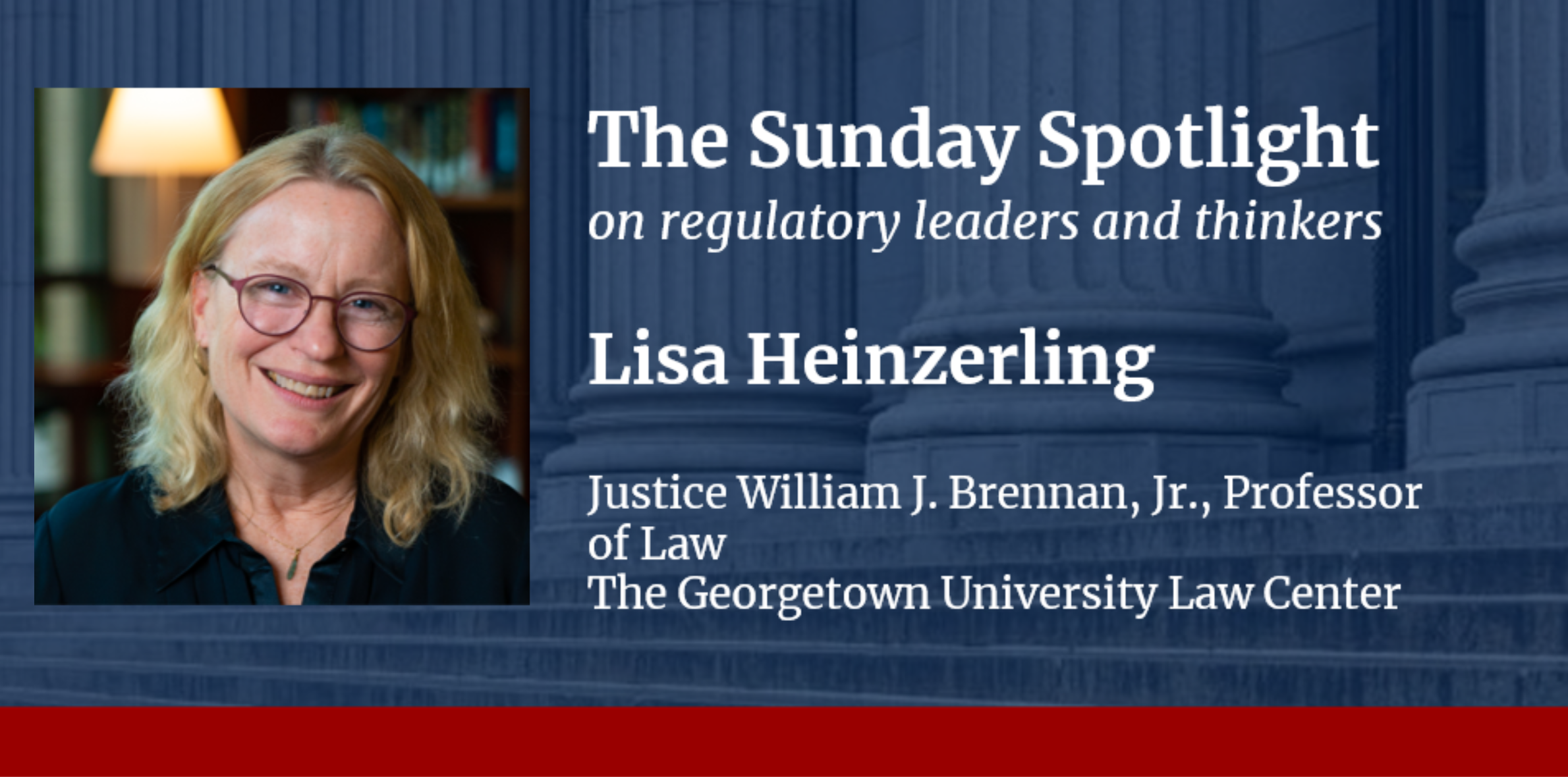
Heinzerling is the Justice William J. Brennan, Jr., Professor of Law at the Georgetown University Law Center. Previously, Heinzerling served as a public member of the Administrative Conference of the United States and a chair of the board of the Center for Science in the Public Interest. Heinzerling has also served as senior climate policy counsel to EPA, associate administrator of EPA’s Office of Policy, and as a member of President Barack Obama’s EPA transition team.
Heinzerling’s scholarship focuses on developments in environmental and administrative law. In her book Priceless: On Knowing the Price of Everything and the Value of Nothing, Heinzerling critiques the use of cost-benefit analysis in environmental policies. She has also written casebooks on environmental and administrative law. Heinzerling has litigated environmental law cases and was the lead author of the winning briefs in Massachusetts v. EPA, in which the Supreme Court recognized EPA’s authority to regulate greenhouse gases under the Clean Air Act.
The Regulatory Review is pleased to share the following interview with Lisa Heinzerling.
The Regulatory Review: Why have you criticized the use of cost-benefit analyses in establishing environmental policies?
I have criticized the use of formal cost-benefit analysis—which entails quantifying, monetizing, and discounting the costs and benefits of environmental policies—for several reasons. First, most of our federal environmental statutes do not require, and some do not allow, formal cost-benefit analysis. Second, the process of quantifying and monetizing human lives, health, and nature leaves many environmental values on the cutting-room floor because they can be hard to quantify and monetize. Finally, the practice of discounting future environmental benefits—an operation that works like compound interest in reverse, greatly devaluing events that occur in the future—is at odds with the future-oriented premises of our federal environmental statutes and with basic moral intuitions about the equal worth of future beings.
TRR: If not through cost-benefit analyses, how should environmental policies be evaluated?
Cost-benefit analysis has been required by Presidents as an extra-statutory criterion for judging environmental policies set under federal laws. Instead of evaluating these policies through the lens of cost-benefit analysis, I would recommend evaluating them according to the statutory criteria set by the U.S. Congress.
TRR: You led the winning briefing in Massachusetts v. EPA, in which the Court held that EPA can regulate greenhouse gases under the Clean Air Act. What are the lasting impacts of that case on environmental law today?
The lasting impacts of Massachusetts v. EPA are that it led to the first official, legally consequential finding from the U.S. government that greenhouse gases endanger public health and welfare, and to the first federal regulatory programs for greenhouse gases. The endangerment finding is not easy to dislodge on its own, scientific terms, as we’ve witnessed in the current Administration’s rather tortured attempts to undermine the finding without directly questioning it. The federal regulatory programs showed that greenhouse gases can be brought into the regulatory fold without causing undue economic distress to the relevant industries. These lessons persist even as the present Administration denies them.
TRR: In Loper Bright Enterprises v. Raimondo, the Supreme Court overruled Chevron U.S.A. v. Natural Resources Defense Council, which had held that courts should defer to agencies’ reasonable interpretations of ambiguous statutes. You have argued that the Supreme Court’s recent decision in Loper Bright—which held that courts may no longer defer to agencies’ interpretations of ambiguous statutes—does not apply to most Clean Air Act regulations. What is the significance of this decision for environmental law?
I have argued that Loper Bright does not apply to most rules issued under the Clean Air Act because the Clean Air Act’s specific provision for judicial review does not contain the statutory language—from the Administrative Procedure Act—that the Court relied on in rejecting deference to agencies’ interpretations. I do not think the courts will accept my reasoning; before my piece came out, the U.S. Court of Appeals for the D.C. Circuit had already rejected the idea that Loper Bright does not apply to Clean Air Act rules.
Loper Bright will likely be very significant for environmental law. Environmental cases involve the kinds of complex, technical, evolutive problems that, as Justice Elena Kagan has put, “Chevron was built for.” At the same time, the majority opinion in Loper Bright left room for respecting, even if not deferring to, agencies’ interpretive views. The decision also could open up judicial imaginations that were long stunted by the rigid and often rote two-step analysis of Chevron. Loper Bright was a blockbuster decision, but we are still in the early days of understanding its full implications.
TRR: EPA recently rescinded its 2009 greenhouse gas endangerment finding. What is the significance of that finding for greenhouse gas regulation, and what effect might the rescission of the endangerment finding have on the environment?
The Clean Air Act premises regulation of a variety of pollution sources on a finding by EPA that the sources’ emissions contribute to air pollution that endangers public health or welfare. The endangerment finding thus underpinned all of EPA’s greenhouse-gas regulations under the Clean Air Act. With that finding in hand, EPA regulated such sources as passenger cars, heavy trucks, power plants, and oil and gas facilities. As EPA repeals its findings of endangerment, it is repealing the regulations that control greenhouse gases. In addition, EPA’s novel legal arguments for repealing the endangerment finding—such as its insistence that the Clean Air Act incorporates common-law principles such as proximate causation—may have negative repercussions for the agency’s regulatory authority over conventional air pollution.
TRR: What legal challenges might EPA face to its rescission of the greenhouse gas endangerment finding?
Every possible legal challenge under the sun: constitutional, statutory, procedural, deliberative. The first lawsuits were filed within a week of the repeal.