

The Next Front for Reigning in Regulatory Preemption
The next logical step to limit the administrative state is shown by recent Supreme Court concurrences.

The Challenge of Regulatory Preemption in AI Governance
Courts should defer to persuasive agency interpretations of statutes.

Buy the Evidence, Do Not License the Model
Congress should require independent evidence for AI models through the procurement process.
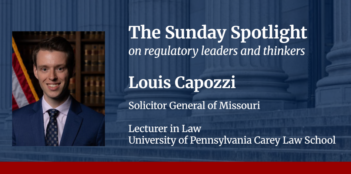
The Role of States in Shaping National Regulation
Louis Capozzi examines how state-level officials challenge and defend federal regulations.

Health Care Fraud in a Time of Increased Judicial Scrutiny
Scholar warns that the fall of Chevron deference could destabilize health care fraud enforcement.

Municipalities Need a New Risk Assessment Tool
A proactive framework for analyzing regulations can help municipalities regulate without Chevron deference.

Federal Court Sidesteps Important Questions on Title IX Athletics
A recent case signals threat to protections for women in intercollegiate sports.

Judicial Deference and FDA
Scholar argues that limited judicial deference to agencies may matter less for FDA than health experts fear.

The Evolution of Environmental Regulation
Lisa Heinzerling discusses recent developments in environmental law and regulation.

Interpreting Civil Rights Statutes
Katie Eyer discusses how courts’ statutory interpretation shapes civil rights enforcement.

The Regulatory Rule of Law and Reasoned Decision-Making
The Roberts Court should follow its own reasoned decision-making requirements to constrain regulatory demolition.

Some Doubts About the Duty of Reasoned Decision-Making
The Supreme Court should reconsider the doctrine requiring courts to take a hard look at agency policy changes.