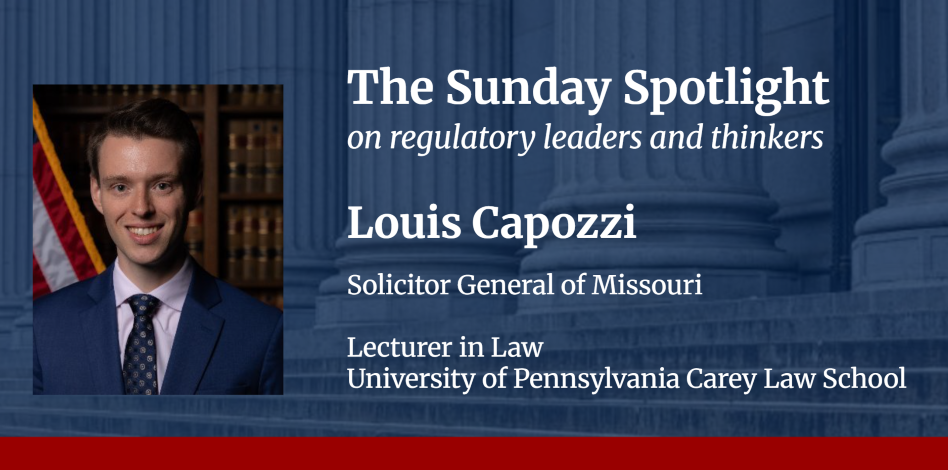
Louis Capozzi examines how state-level officials challenge and defend federal regulations.
In a conversation with The Regulatory Review, Louis Capozzi, the Solicitor General of Missouri, discusses what motivates state officials to initiate or intervene in legal challenges to federal regulatory policies.
Capozzi explains that states created solicitor general offices to remedy the perception that state interests were poorly represented in high-profile national litigation. He observes that although states frequently challenge federal regulations, states with a concrete interest in regulations will sometimes defend them in court. He emphasizes that state legal officials have advantages as litigators in terms of resources, special doctrines, and access to a wide range of forums, which make state solicitors general well positioned to shape regulatory policy. Capozzi also emphasizes the importance of the U.S. Supreme Court’s major questions doctrine, which provides that Congress must clearly authorize agencies to undertake major regulatory initiatives before a court will recognize an agency’s authority to do so.
Capozzi has been the Solicitor General of Missouri since July 2025. He is a lecturer in law at the University of Pennsylvania Carey Law School, where he has taught courses on administrative law and the Supreme Court. He clerked for U.S. Supreme Court Justice Neil Gorsuch in the 2021 term and, before that, Judge J. Harvie Wilkinson of the U.S. Court of Appeals for the Fourth Circuit and Judge Anthony Scirica of the U.S. Court of Appeals for the Third Circuit. He was valedictorian of the Class of 2019 at Penn Carey Law.
The Regulatory Review is pleased to share the following interview with Louis Capozzi.
TRR: The position of state solicitor general is relatively new in most states. What effect has the growth of this office had on the relationship between local and national policy?
Capozzi: States are the most prominent litigants that challenge federal regulatory policies. The question, then, is whether states will be formidable litigation opponents. In prior decades, there was a perception—especially at the U.S. Supreme Court—that states were poorly represented in high-profile cases. In response, states created solicitor general offices, which have definitely made states more successful in litigating against the federal government. If you look at the successful challenges to federal regulations over the past decade or so, state solicitors general were often the individuals bringing those cases.
TRR: What role do regulation and regulatory policy play in your work as the Solicitor General of Missouri?
Capozzi: Assessing how federal regulations benefit or harm Missouri is one of the most important parts of my job. Undoubtedly, challenging federal regulations are a bigger part of a state solicitor general’s job when the federal government is controlled by the opposite political party. But even now, we still sue the federal government sometimes. Right now, Missouri is litigating against the Trump Administration in three significant cases—related to the regulation of mifepristone, the inclusion of illegal aliens to determine congressional apportionment, and the mass student loan cancellation program initiated under the Biden Administration.
On the other hand, in cases where Missouri has concrete interests, we sometimes litigate alongside the federal government in defending federal regulations. For example, we are currently intervenor-defendants in federal courts in Washington, D.C., and Massachusetts in cases that challenge President Donald J. Trump’s election integrity executive order.
TRR: In recent years, state-level litigants and officials have played a significant role in shaping national regulatory policy. What impact will this dynamic have on the future of regulation and deregulation?
Capozzi: State solicitors general are well positioned to help shape regulatory law in the coming years. States have significant advantages as litigants, including resources and special doctrines—such as parens patriae standing, which sometimes allows states to sue to protect the interests of their citizens—that allow them to bring big lawsuits.
States also have significant discretion on where they sue. States can sue in federal courts within their own borders. But if they recruit other states as co-plaintiffs, they can also sue in federal courts around the country. That enables substantial forum-shopping when states bring lawsuits against the federal government. For example, in one of the cases involving President Trump’s election integrity election order, California is the lead plaintiff, but it sued in Massachusetts. It did so because it believed that would be a favorable forum.
TRR: In 2024, in Loper Bright Enterprises v. Raimondo, the U.S. Supreme Court overturned the Chevron doctrine, under which courts deferred to agency interpretations of ambiguous statutes. What changes in agency regulations, if any, have you seen as a result of that decision?
To be frank, I have not seen a significant change in agency behavior since the overruling of Chevron. As a practical matter, part of the reason is that Chevron’s standing was weak for quite some time before the Supreme Court formally discarded it. Other doctrines, such as the major questions doctrine, are much more practically significant in shaping agency behavior right now.
TRR: You have written in defense of the major questions doctrine. How do you understand that doctrine, and how do you anticipate that it will shape the regulatory landscape in the coming years?
Capozzi: The major questions doctrine is currently the most significant legal constraint on the power of the executive branch to impose new policies. At the risk of oversimplifying, the major questions doctrine channels “major” policy changes to Congress. The doctrine has particular bite when federal agencies try to repurpose broad, vague language in old statutes to solve new problems that Congress did not actually consider.
The major questions doctrine has had a huge impact on administrative law since 2020. The Supreme Court relied on that doctrine to reject President Joseph R. Biden’s eviction moratorium, halt a COVID-19 vaccine mandate, and prevent the imposition of cap-and-trade rules to combat climate change. The Supreme Court also applied the doctrine to block President Trump’s tariffs. Given the reality that Presidents from both political parties have been incentivized to solve major problems unilaterally—rather than working with a slow, inefficient Congress—you should expect to see more landmark cases under the major questions doctrine in the coming years.