
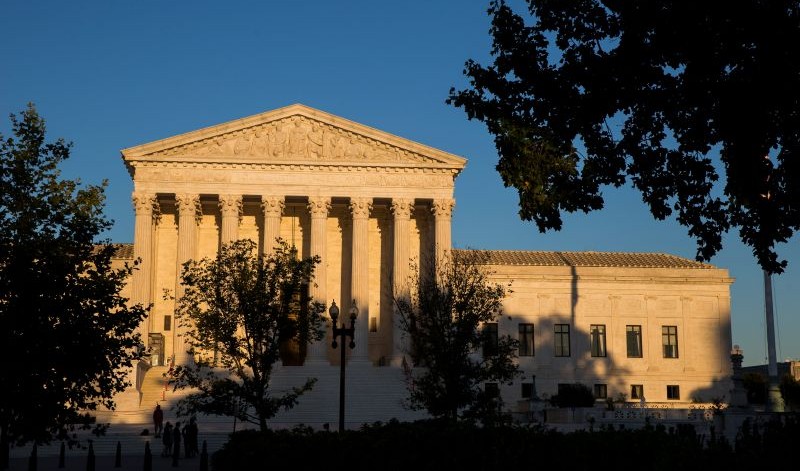
The next logical step to limit the administrative state is shown by recent Supreme Court concurrences.
At the end of its most recent term, the U.S. Supreme Court decided two cases that signal what likely will be the next line of attack to limit the federal administrative state. In Monsanto Co. v. Durnell the Court held that a federal statute preempted state-law failure-to-warn claims involving Roundup weedkiller. In Trump v. Slaughter, the Court overruled Humphrey’s Executor v. United States and held that a statutory provision requiring the President to have cause to fire Commissioners of the Federal Trade Commission is unconstitutional. Neither outcome should have come as a surprise to Court scholars.
Less expected, but of potentially great significance, were the concurring opinions in Monsanto and Slaughter. Both, in their own way, prompt lawyers to challenge existing Supreme Court precedent about the force and effect of federal regulations on conflicting or inconsistent state law.
Most direct was Justice Clarence Thomas’s Monsanto concurrence. He explained that federal preemption, under which federal law supersedes conflicting state laws, arises from the U.S. Constitution’s Supremacy Clause, which only covers “this Constitution,” “laws of the United States which shall be made in pursuance thereof,” and “treaties.” Federal regulations are clearly not the Constitution or a treaty. And they are hard to characterize as the “laws” referenced in the Supremacy Clause because the U.S. Congress did not create them through the bicameral process and subject only to categorical veto, not line-item editing, by the President. And if such regulations are not “laws of the United States,” they alone cannot preempt state law.
Less direct, but similarly bold, was Justice Neil Gorsuch’s Slaughter concurrence. He endorsed the rejection of Humphrey’s Executor but explained how a consequence of doing so is to increase the President’s control over administrative agencies that exercise sweeping authority to regulate financial markets, businesses, employment, and more. Justice Gorsuch acknowledged that allowing so much “power to accumulate in the President’s hands invites real risks.” As a result, he admitted, the “Court has some work to do” to fix the problem of a too powerful, and newly centralized, administrative state. That work includes “restoring legislative … powers to where they belong: in Congress,” not the executive branch.
The Court in recent years has already taken some action to rein in the administrative state, including by limiting deference to government agencies’ interpretation of federal statutes, as in Loper Bright Enterprises v. Raimondo, and requiring Congress to be clear in its delegation of “extraordinary” power to agencies, as in West Virginia v. EPA. Justices Thomas and Gorsuch appear to envision the next step to be judicial confirmation that federal agencies cannot displace the authority of sovereign state governments and the role of independent state law without clear direction from the more politically accountable legislative branch.
This is not a new or novel concept. I first wrote about it roughly 20 years ago in Supremacy Clause Limitations on Federal Regulatory Preemption. Restricting such preemption would force Congress to make the tough calls on when state law needs to be blocked, rather than punting such calls to more insulated federal agencies. The change would allow states to oppose such preemption by lobbying one body—Congress—rather than trying to monitor and influence countless federal agencies. And this change would reduce the burden on courts trying to resolve disputes over when state-by-state legal flexibility and variability must give way to a need for national uniformity—as decided by Congress subject to presidential veto, not by unelected administrators.
The state of the law today, as reflected in decisions such as Watters v. Wachovia Bank, allows federal regulations to preempt state law even without unmistakable Congress endorsement. But I believe that Chief Justice John G. Roberts, Jr.—who dissented in Watters—and at least Justices Thomas, Samuel A. Alito, Jr., Gorsuch, and Brett Kavanaugh are willing to revise and reform that doctrine and largely eliminate such autonomous preemption. Justice Amy Coney Barrett may also be so willing, though her views on the issue are less clear.
What advocates need to do now is press, and preserve, this issue—both in tort cases raising preemption issues and in court and administrative actions challenging federal regulations. They may face short-term defeats, but they will be vindicated in the longer term—and succeed in further curbing overreach by the federal bureaucracy.