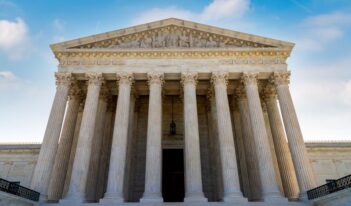

Slaughter and Cook rely on historical inaccuracies while raising new questions about agency independence.
It seemed to be only a matter of time before the Roberts Court would overturn Humphrey’s Executor v. Federal Trade Commission, the unanimous precedent from 1935 that allowed agency independence, via good cause requirements for presidential removal, so long as the agency exercised “quasi-judicial” or “quasi-legislative” power. After its unsigned order a year earlier in Trump v. Wilcox, it also seemed inevitable that the Roberts Court would preserve the independence of the Federal Reserve at the same time. The only real questions were: How would the U.S. Supreme Court save the Federal Reserve? And would the Court leave room for removal protections for any other executive branch officers?
The short answers are: In Trump v. Cook, Chief Justice John G. Roberts, Jr., relied on historically inaccurate claims about the First and Second Banks of the United States as a founding-era precedent for the Federal Reserve to uphold its independence—and only by a surprisingly razor-thin 5–4 vote. And yes, in Trump v. Slaughter, Chief Justice Roberts left room for other agency independence, but it is a dark and small room. And the Court also invited new doubts: Can inferior officers be protected? What about administrative law judges and Article II adjudicators? And surprisingly, is the civil service safe?
In Trump v. Slaughter, Chief Justice Roberts crystallized a multi-decade project of overturning Humphrey’s in one sentence: “When an agency executes a congressional mandate against private parties, it exercises executive power—no ifs, ands, or quasis about it.”
One could say that Chief Justice Roberts was going to overturn Humphrey’s but save the Federal Reserve, no ifs, ands, or originalist interpretations of the Constitution. The die had been cast a year earlier. In Wilcox, the Supreme Court had already repeated its maximalist and ahistorical interpretation of Article II in one paragraph, and then it contradicted it in the next paragraph with a myth about the Federal Reserve.
In Slaughter and Cook, Chief Justice Roberts repeated debunked myths and assumptions about constitutional clauses that were reminiscent of Warren Court “penumbra and emanation” wish-fulfillment. In dissent, Justice Sonia Sotomayor summarized a mountain of contrary evidence, especially from the last decade of scholarship, but Chief Justice Roberts ignored or dismissed almost all of it.
Let’s start with the controversial term “quasi-judicial.” Yes, along with Chief Justice Roberts, many modern readers assume the term is a modern legal fiction contradicting the founders’ design of the separation of powers. However, Justice Sotomayor explained that the term has a long pedigree back to England and the founding era, citing works by Noah Rosenblum, Nathaniel Donahue, Beau Baumann, and me.
None of Chief Justice Roberts’s other historical claims stand up to scrutiny. He led with the argument that federal officers derive their offices from the President’s appointment under the Appointments Clause of the U.S. Constitution and consequently can be removed by the President. Never mind that this argument goes against the text of the Constitution and goes against the overwhelming evidence about the original public meaning of that text. He relied on sources drawing on English royal practices written before the framers drafted the Appointments Clause, which deliberately rejected royal unilateral appointment power—as Justice Antonin Scalia had emphasized in National Labor Relations Board v. Noel Canning and elsewhere. He even plucked a single sentence from a fragmentary Thomas Jefferson note, omitting the sentences in the same note that contradicted his interpretation.
Chief Justice Roberts imported assumptions about the English Crown’s powers, but Justice Sotomayor correctly rebutted those assumptions, stating that “the powers held by the English Crown and state governors before ratification did not include a removal power that the legislature could not modify.” Indeed, the Supreme Court has just given the President powers over administration greater than those of the British monarchs. Justice Sotomayor cited recent historical research, including my finding that, “in England, many high offices, and even ‘great offices,’ department heads, and cabinet-level offices were unremovable by the Crown.”
Chief Justice Roberts is no more accurate in his claims about the Executive Vesting Clause, Take Care Clause, and so-called Decision of 1789 (there was no decision!). Nor is he correct about a bizarre theory suggesting that the President is the directly accountable representative of the nation (never mind the Electoral College, term limits, and the writing of the framers themselves) or a confusing theory of “liquidation” through later practice (a cherry-picked theory based on cherry-picked evidence).
Chief Justice Roberts is also unable to substantiate his reliance on the Banks of United States in Cook for a gerrymandered exception for the Federal Reserve. Justice Clarence Thomas was right in his dissent: “The problem for the Court is that the First and Second Banks were banks with no executive power, whereas the Board is unquestionably a federal agency that wields considerable executive power.” Chief Justice Roberts replied with a grossly misleading claim, taking a quotation out of context.
Conservative originalists correctly criticize the Roberts Court for engaging in the kinds of “penumbra” and “emanation” arguments that originalists ridiculed when coming from the Warren Court. The Roberts Court has become a “Conservative Warren Court.” Chief Justice Roberts has repeatedly twisted American history and engaged in “Article II vibes” to serve his own political preferences—no ifs, ands, or originalism(s).
So, what independence remains? Why did Chief Justice Roberts avoid any reference to the traditional tripartite categories of “principal officers,” “inferior officers,” and “employees?” Justice Neil Gorsuch’s concurrence emphasized the importance of presidential control over principal officers, implicitly distinguishing them from inferior officers and the civil service. Notably, Article II never used the term “principal officer” in the Appointments Clause. It has been grafted into the appointments and removal jurisprudence from a reference in the Opinions Clause: The President “may require the opinion, in writing, of the principal officer in each of the executive departments.” The textual and originalist grounds for all of this jurisprudence is questionable, at best. One way to cabin Slaughter is to limit it in future cases to “department heads” or powerful commissions that are comparable to department heads, such as the Federal Trade Commission
What about administrative adjudication? Perhaps there are five votes to distinguish principal officers from inferior officers such as administrative law judges. Recall footnote 10 in Free Enterprise Fund vs. Public Company Accounting Oversight Board in 2010: “Our holding also does not address … administrative law judges” who “perform adjudicative rather than enforcement or policymaking functions.” If the President can remove all principal officers at will (except the Federal Reserve Board), then the Free Enterprise rule against double layers of insulation is obsolete, a vestige of Humphrey’s. Perhaps inferior officers such as administrative law judges can be protected under these new interpretations of Article II, as they are supervised by more accountable principal officers.
Moreover, independence for “adjudication” seems to be an open question. In the Slaughter oral arguments, Chief Justice Roberts and Justice Brett Kavanaugh asked questions in search of a limiting principle on the unitary executive theory, worrying about the fate of adjudicatory administrators and Article I judges. In his majority opinion, Chief Justice Roberts’s sweeping constitutional interpretations and maximalist phrasings seemed to leave no room for such independence, until near the end of the opinion where he cracked open a door for the judges of “‘non-Article III courts,’ such as the Tax Court and the Court of Federal Claims.” Chief Justice Roberts referred to “non-Article III courts,” instead of the narrower “Article I courts” that he and Justice Kavanaugh specified in oral argument—hinting at protecting Article II adjudicators such as administrative law judges. Did Free Enterprise Fund and Slaughter quietly preserve the quasi-judicial category, even if we are no longer allowed to call it “quasi-judicial?” It reads like the same intuition or principle.
What about the civil service? The Roberts Court already jeopardized the civil service’s independence by declining to hear Harris v. Bessent, leaving in place the U.S. Court of Appeals for the D.C. Circuit’s ruling against the independence of the Merit Systems Protection Board. As a result, the Board no longer calls itself “independent.” How much will that change undermine the civil service, and is the civil service facing further danger?
Language from the opinions in Slaughter and Cook also indicate that other examples may be drawn from early Congresses’—and early Presidents’—“contemporaneous legislative exposition” and independence when influencing “monetary policy.” Although Chief Justice Roberts misused the Banks of the United States, other commissions and offices created by early Congresses served as a foundation for Federal Reserve independence and other commissions with sensitive monetary and fiscal powers. The Chief Justice also left open offices “of an investigative and informative nature,” which may “be regarded as merely in aid of the legislative function of Congress”—perhaps a new “quasi-legislative” category? Lo and behold, a day after deciding Slaughter and Cook, the Roberts Court allowed an injunction to continue protecting the Register of Copyrights and Director of the U.S. Copyright Office, whose duties under the Librarian of Congress include adjudication and administrative rulemaking.
In any event, it seems like the Roberts Court is keeping its options open to preserve some agency independence—not based upon careful history, but perhaps based on a mix of common sense, the importance of fair adjudication, and some connection to the legislative powers of the purse and Congress’s interests in information and investigation.
Humphrey’s old quasi-judicial category is dead. Long live Slaughter’s new quasi-judicial category.

This essay is part of a series titled, “The Supreme Court’s 2025–2026 Regulatory Term.”