
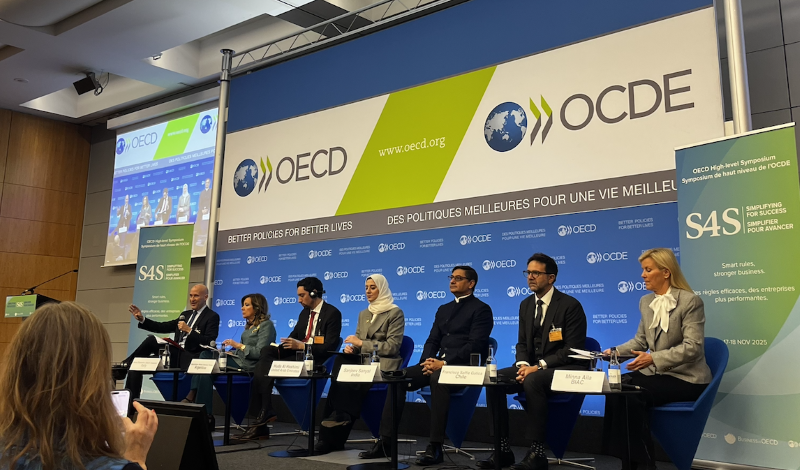
Scholars and practitioners from around the world explore regulatory simplification and how best to ease regulatory burdens.
The Organization for Economic Cooperation and Development (OECD) convened a symposium in Paris late last year on “Simplifying for Success,” bringing government officials, business leaders, and academic experts from around the world to identify solutions to ease regulatory burdens while keeping societies safe.
The symposium discussions centered on an OECD issue brief summarizing the principal findings of surveys conducted among public sector and private sector delegates to the OECD Regulatory Policy Committee. Notably, business leaders in 90 percent of surveyed countries and government leaders in 72 percent consider the level of regulation and bureaucracy in their countries too burdensome.
Prompted by this perception, many countries around the world have developed initiatives to combat regulatory burdens and simplify compliance requirements for businesses. Argentina’s government, for example, celebrates a “chainsaw austerity” approach that views deregulation as a form of regulatory simplification. The Italian government, as another example, has created a ministerial position for regulatory simplification.
The OECD observes that a growing volume of regulations, combined with rapid technological change, has led governments to layer new rules onto existing rules, which has resulted in increasingly complex regulations and rules for the public and private sectors alike.
But the OECD recognizes that the kinds of regulatory simplification initiatives seen in some countries can sometimes focus too much on integrating new technologies that promise greater efficiency, while overlooking unintended consequences, including the diversion of resources from innovation and investment.
The OECD suggests that governments conduct ex post reviews of existing regulations, eliminate duplicative rules, and target sectors that face high regulatory burdens, such as the construction and real estate sectors.
The OECD’s “Simplifying for Success” initiative expands upon over 30 years of effort to reduce regulatory burdens—work that continues today.
This series features essays from the following speakers, participants, and attendees of “Simplifying for Success”: Aakanksha Arora, India’s Economic Advisory Council; Karson L. Taylor, The Regulatory Review; Maria Casellati, Italy’s Department for Institutional Reforms; Maria De Benedetto, Roma Tre University; Sanjeev Sanyal, India’s Economic Advisory Council; and Veronica Taylor, Australian National University.
Regulating to Build Better
April 6, 2026 | Maria De Benedetto
Cutting red tape alone will not solve the housing affordability crisis.
Regulatory Simplification as a Strategic Priority
April 7, 2026 | Maria Elisabetta Alberti Casellati
Italy’s government recognizes regulatory simplification as a strategic priority.
Fixing the Nuts-and-Bolts of the Economy
April 8, 2026 | Sanjeev Sanyal and Aakanksha Arora
Process reforms can improve the administration of India’s voluntary company liquidation pathways.
A Postcard from Abroad on Regulatory Simplification
April 9, 2026 | Veronica Taylor
More work is needed to simplify regulations while preserving their benefits.
Regulate Smarter, Not Harder
April 10, 2026 | Karson L. Taylor
A recent OECD symposium emphasized the need to balance regulatory protection with burden reduction and simplification.