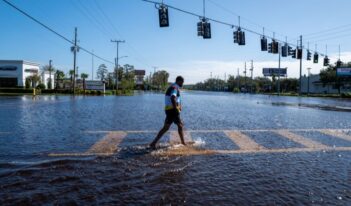

Proposed reforms to the National Flood Insurance Program will only further concentrate risks.
The National Flood Insurance Program (NFIP), which provides federally backed flood insurance, is broke, broken, and indispensable. The U.S. Congress has until December 11, 2026, to reauthorize it, making the current authorization the 36th short-term extension since 2017. Congress has not settled on a long-term solution: The program has lapsed twice in the last 12 months and each time has been retroactively reauthorized by a continuing resolution. The President’s Federal Emergency Management Agency (FEMA) Review Council, established by an executive order last year, recently released its final report on the NFIP and wants Congress to use its upcoming vote to start handing the program back to private insurers. The Review Council correctly diagnosed the core problems: The NFIP owes the U.S. Department of the Treasury $22.5 billion, has failed for decades to deter development in flood-prone areas, and pays an outsized share of its claims to a small set of properties that have experienced repeated insurance losses. But the Review Council’s prescription makes all three problems worse.
The Review Council’s seventh recommendation calls for a voluntary “take-out” program that would transfer some NFIP insurance policies to private insurers, create a new flood insurance marketplace, and continue moving toward fully risk-based insurance premiums under the Risk Rating 2.0 methodology, which the Federal Emergency Management Agency (FEMA) began applying to new policies in 2021. The premise is that more accurate risk signals plus private capital will produce a better functioning flood insurance market. The evidence shows that the premise does not hold.
Flood risk fails the basic conditions for private insurability. Insurers diversify their exposure to risk by pooling many independent exposures so that one bad event affects only a small share of policies. Flood does the opposite. A single hurricane concentrates losses along a stretch of coast, and a single atmospheric river or convective storm concentrates them across an inland watershed; either way, thousands of geographically contiguous policies file claims at once. Private flood insurers reached this conclusion after the 1927 Mississippi floods and exited the market. Congress created the NFIP in 1968 because no one else would provide coverage. The Fifth National Climate Assessment finds that coastal flooding will occur five to ten times more often by 2050 than in 2020. The Guadalupe River flooded central Texas in July 2025, killing more than 130 people, and the same region flooded again in July 2026. Both struck hundreds of miles from any coast.
California has already run this experiment in a related market. Wildfires share the defining feature of floods—correlated catastrophic risk that breaks private diversification. Seven of California’s 12 largest homeowners insurers, constituting roughly 35 percent of the market, paused or restricted new policies between 2022 and 2024. The California FAIR Plan, the state’s insurer of last resort, grew 276 percent from 2018 to 2024, reaching $603 billion in residential exposure. When the Palisades and Eaton fires struck in January 2025, the FAIR Plan paid nearly $3.5 billion in claims and triggered $1 billion in mandatory additional payments from private insurers that were members of the plan. Many homeowners who were not renewed by the private market go without coverage altogether.
Risk Rating 2.0 is the pricing benchmark on which the Council’s take-out program would run. Under its proposal, an NFIP policyholder whose risk-rated premium falls within 10 percent of an available private rate would be required to accept the private policy. While the methodology is technically sound, its political and demographic record disproves the Review Council’s premise. FEMA’s own data show that 77 percent of NFIP policyholders now pay more than under the old system. Peer-reviewed research published in December 2025 found that Risk Rating 2.0 drove an 11 percent to 39 percent decline in new NFIP policies and a 5 percent to 13 percent decline in policy renewals, with the steepest drops occurring in the lowest-income zip codes. Layering privatization on top will accelerate a coverage collapse that the data already document. The bipartisan congressional Flood Resilience Caucus wrote to the FEMA Review Council in August, warning that the take-out program risks drawing the lowest-risk policies into private hands while leaving the residual public pool worse off. The Congressional Research Service separately noted that it is unclear how FEMA could require policyholders to leave the NFIP or what would happen if private insurers later drop those policies.
The Review Council’s recommendation would withdraw the federal flood backstop at the moment that the federal government’s own climate assessment warns that the market is most stressed. A privatized marketplace will sort the risks. Private insurers can quote inland policies within 10 percent of the Risk Rating 2.0 benchmark and move them out of the NFIP under the Council’s rule. They will either quote coastal policies so far above the benchmark that the policyholder stays in the NFIP or decline to quote them at all. The residual public pool will then hold a worse risk mix at premiums that most exposed households cannot pay. That coverage collapse means that as damages occur, lower-income households will not be able to rebuild. FEMA’s own data show the gap: Households with NFIP policies received average claim payments of $66,000 between 2016 and 2022, while uninsured households averaged $3,000 in federal disaster assistance.
Florida holds 38 percent of all U.S. flood policies, Texas holds 13 percent, and Louisiana relies on the NFIP for 97 percent of its flood coverage. FEMA’s own state-level data show that 80 percent of Louisiana NFIP policyholders face premium increases under Risk Rating 2.0, with average projected increases exceeding 100 percent. Decades of federally subsidized development drew families into those floodplains. Withdrawing the backstop from precisely those communities is not a neutral market correction.
Workable options exist. The proposed bipartisan National Flood Insurance Program Reauthorization and Reform Act of 2025 would extend the NFIP through 2030, cap annual premium increases at 9 percent, create income-based affordability vouchers, and expand investment in flood mapping and mitigation. More fundamentally, Congress can subsidize coverage transparently and means-test it so that support reaches households that need protection. Congress can also invest in physical mitigation and enforce the land-use restrictions that the Council’s own report endorses elsewhere. Or Congress can accept that the federal government will bear catastrophe costs through disaster aid rather than premiums and plan accordingly.
The Council’s proposal does none of these. It chooses privatization and leaves the highest-risk households neither with functioning flood insurance coverage nor a workable alternative.



The views expressed in this essay are those of the authors and do not necessarily reflect those of any organization with which they are currently or previously affiliated.