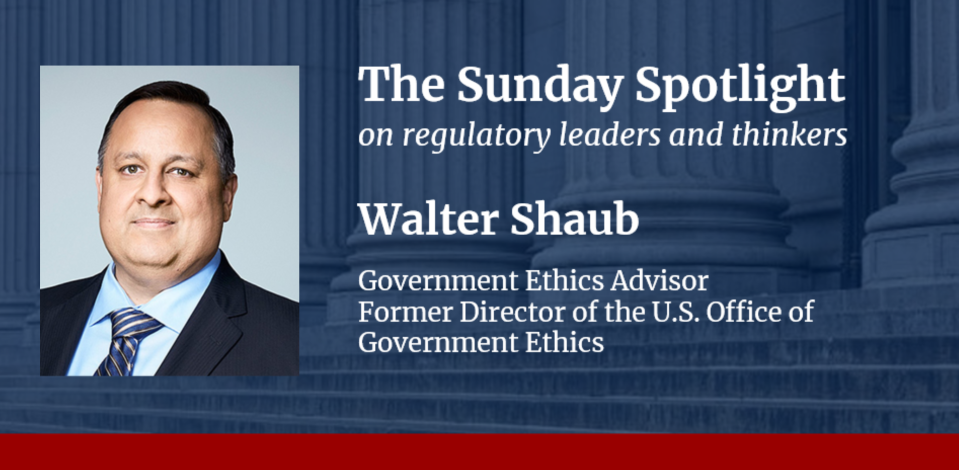
Walter Shaub reviews the state of federal government ethics and challenges to government accountability.
In a recent conversation with The Regulatory Review, Walter Shaub, the former director of the U.S. Office of Government Ethics (OGE) and a current government ethics advisor, discusses the erosion of federal ethics enforcement under the first and second Trump Administrations.
Concerns about government ethics are not new, but Shaub maintains that the current moment represents a break from anything the country has seen before. Pointing to the sidelining of independent watchdogs such as the Merit Systems Protection Board (MSPB) and the Office of Special Counsel (OSC), Shaub argues that the second Trump administration is dismantling ethics and accountability as we know it. As civil service protections meant to guard against retaliation are stripped away and politically motivated firings become the norm within executive agencies, this current moment represents a calamity in government ethics, contends Shaub. Shaub fears that the judiciary cannot stop this calamity. He contends that the U.S. Supreme Court has shown a pattern of deference to executive power that leaves few institutional checks intact, even as litigation and public engagement remain important tools for accountability advocates.
Drawing on his extensive experience in government ethics, Shaub reflects on how his own recommendations for reform have changed since 2017. He considers what meaningful institutional rebuilding might require going forward.
Shaub served at OGE for over 11 years, almost five of those years as its Director. Since leaving OGE, Shaub has continued to function as a government ethics expert, leading the government ethics program at the Campaign Legal Center as senior ethics director, advising Citizens for Responsibility and Ethics in Washington in a legal capacity, leading the Project on Government Oversight’s Ethics and Accountability Initiative, working as an on-air contributor for CNN, and, in recent years, working as an outside consultant to watchdog groups. From 2024 to 2025, Shaub was also a distinguished policy fellow at the University of Pennsylvania Carey Law School.
The Regulatory Review is pleased to share the following interview with Walter Shaub.
TRR: Since your time in government, what trends have you noticed in government ethics at the federal level? What is the current state of federal government ethics?
Shaub: President Donald J. Trump’s first administration was an ethics calamity. President Joseph R. Biden returned the ethics program roughly to what it was under President Bill Clinton and President George W. Bush, but he fell far short of delivering the renaissance it needed after years of President Trump’s ethical failure. President Trump’s second term killed the ethics program and buried it in an unmarked grave in the woods. Lack of transparency makes ascertaining whether laws are being broken difficult, but legality is beside the point. President Trump made $2 billion last year. Enough said. The nation is witnessing corruption on a grand scale. Meanwhile, U.S. Supreme Court justices disgrace the judiciary by refusing to recuse when their participation in cases is problematic, accepting lavish gifts, hawking books that sell because of the authors’ high positions, giving closed-door speeches to preferred audiences, and moonlighting as professors. On Capitol Hill, lawmakers refuse to divest the sorts of conflicting investments they expect presidential nominees to divest.
TRR: Ethics and accountability rules touch many agencies — the U.S. Office of Personnel Management, the Office of Management and Budget, and others. What policy changes are you most closely watching at these agencies?
Shaub: I am most concerned about changes to the civil service. I have always considered civil service laws and regulations integral to government ethics. These laws and regulations guard America against the dangerous consequences of officials facing whistleblower retaliation, firings based on party affiliation, and being compelled to obey patently unlawful orders. An aspiring autocrat must destroy any merit-based system of government employment to punch through the boundaries of presidential authority. This destruction requires autocrats to push out senior and mid-level officials who have demonstrated loyalty to country and to replace them with individuals who profess loyalty to one politician. That move comes straight from the fascist playbook. Only devotees of the cult of personality can be trusted to help smash democracy.
TRR: Are changes at MSPB and OSC affecting current and former civil servants in practice?
Shaub: Yes. Those changes flow from new leadership and the Supreme Court’s decision not to review a lower appellate court’s decision to allow the President to terminate MSPB members without the cause required by statute. President Trump fired special counsel Hampton Dellinger in February 2025. Dellinger’s replacement, the acting special counsel Jamieson Greer, promptly closed a couple thousand pending complaints. February 2025 also saw Trump fire the MSPB’s chair, Cathy Harris, just before another MPSB member’s term ended. That left only Republican member Henry Kerner until President Trump appointed James Woodruff. The two quickly rocked the foundation of the very merit systems that MSPB exists to protect. Citing presidential authority, Kerner and Woodruff ruled in Jackler and Jaroch v. Department of Justice that the Attorney General could openly violate civil service laws in terminating certain career federal executives. The New York Times reported that, before the decision, White House officials met with Kerner ostensibly to discuss his possible elevation to chair, but that they also discussed the pending case. After the decision, Woodruff became chair.
TRR: With both rules and institutional referees changing, how should advocates for government accountability adapt their strategies when seeking government oversight and accountability going forward?
Shaub: This summer, President Trump said of his conflicting financial interests: “I found out that nobody cared.” He is partly right. The Republican majorities in Congress do not care. His supporters do not care enough to withhold votes. A scene in the documentary A Thousand Cuts, shot from high above a rally for former Philippine autocrat Rodrigo Duterte, shows frenzied cheers from a huge crowd of supporters overflowing the venue. The scene reminded me of President Trump’s rallies before his ratings plummeted. People in thrall to a demagogue do not want to hear dry talk of “ethics.” The word sounds like Emily Post’s etiquette lessons. I do not pretend to have figured out how to reach people. I know I dread what may happen to Southern states in the event of a massive hurricane following President Trump’s purges of the National Weather Service and Federal Emergency Management Administration. Maybe there is common ground if any of his followers do too.
TRR: You have said that the courts are “the last edifice standing” to provide executive guardrails, but they have a “crumbling foundation.” What did you mean by this? If the judiciary cannot reliably enforce government accountability, where should the public turn?
Shaub: The partisan Supreme Court shows contempt for following precedent and seems to harbor the same feeling toward Congress. Too many of its decisions drag us away from democracy. “This Court’s demonstrated enthusiasm for greenlighting this President’s legally dubious actions in an emergency posture,” as Justice Ketanji Brown Jackson wrote, “is routinely manifested through its grotesque abuse of the shadow docket.” Despite the Court’s descent into politics, there have been wins for democracy. Democracy advocates must keep litigating. A win or a partial win slows the fascist project. A loss preserves a record to show where the Supreme Court majority stopped interpreting law and started making—or unmaking—law. Judicial relief is still possible in many cases. Litigation, speaking truth to power, protesting, volunteering, donating money and, most importantly, voting are the public’s most powerful tools. Speaking honestly about the nature of the threat to democracy, not mincing words, matters too.
TRR: Do you think that institutional rebuilding will be required after the second Trump Administration? If so, what would meaningful rebuilding look like?
Shaub: Yes, and there are limits to what reform can accomplish and the political will of foul weather friends. The tiny OGE is subordinate to the President and cannot stop him. President Trump’s firing of OGE’s director in 2025 was inevitable. A post-Nixon ethics act in 1978 did not touch presidential conflicts of interest. A 1989 law reaffirmed the President’s exemption from conflict-of-interest laws. OGE’s legislative authorization expired in 2007 and has not been renewed. In 2021, President Biden restored minimum legal compliance but did not recommit the government to ethics. In 2022, a congressional stock ban failed—and the Democratic speaker of the House proposed to adopt President Trump’s nonblind trust sham for Congress. Chief Justice John G. Roberts, Jr., questioned whether statutory ethics rules for justices would be unconstitutional. In 2024, the Roberts Court majority invented presidential immunity from prosecution. Reform should be pursued, yes. What we need most, though, are leaders who are not corrupt.
TRR: In 2017, you released proposals to strengthen the government ethics program at OGE, emphasizing independence, effective oversight, transparency, and substantive ethics requirements. If you had to revisit these recommendations in 2026, would they remain largely the same or would you change them?
Shaub: They would be completely different. After leaving OGE, I was still optimistically trying to reach both parties and kept the suggestions modest. The Republican chair of the U.S. House of Representatives Committee on Oversight and Government Reform, Trey Gowdy, and the Committee’s ranking member, Elijah Cummings, met with me to discuss the suggestions. Since then, Republicans have consistently blocked ethics reform. To great fanfare, Democrats introduced the For the People Act in 2019. I testified in support of the bill’s ethics provisions, which had good ideas despite needing several significant refinements. In retrospect, I wonder if the bill was meant by some to fail. The bill combined too many topics in a single bill, covering ethics, voting rights, and campaign finance. My recommendations now are not modest. But if a new Congress introduces a multi-topic bill, I will be skeptical that it is nothing more than a publicity stunt. I will believe members of Congress when they propose a dozen or two distinct bills.
TRR: You have advocated government accountability and ethics both from inside government and as an outside watchdog. Which do you find more effective or rewarding — pushing for change from within government or from the outside?
Shaub: Both have benefits and drawbacks. Before President Trump’s election, running the executive branch’s ethics program was meaningful, satisfying work. I am proud of what we did at OGE to make ethics programs both effective and efficient. Maybe that sounds like management-speak, but the staff was truly committed to government ethics and they made a difference. At the same time, I was not free to communicate with Congress from inside government, except in response to requests for technical assistance. Outside government, I volunteer to help congressional staffers directly. I enjoy that. During President Trump’s first term, I also found it useful to have a larger platform outside government. By about 2023, I came to doubt the value in my continuing to engage the public directly. I mostly withdrew from the public eye and shifted to advising advocates, lawyers, lawmakers and, when they are listening, executive branch officials. I think that is how I contribute now.