Accumulated evidence on the harms of gas leaf blowers has bolstered the rationale for regulation.
I argued in a February 2023 essay in The Regulatory Review that regulators should ban gas-powered leaf blowers due to their enormous environmental, public health, and hidden labor costs. Three years later, nearly every major development has strengthened the case for phasing out gas-powered leaf blowers. State and local governments are acting. Industry is fighting back through state preemption laws and constitutional litigation. And a recent federal court decision has exposed the decades-long failure of the Environmental Protection Agency (EPA) to enforce the Noise Control Act.
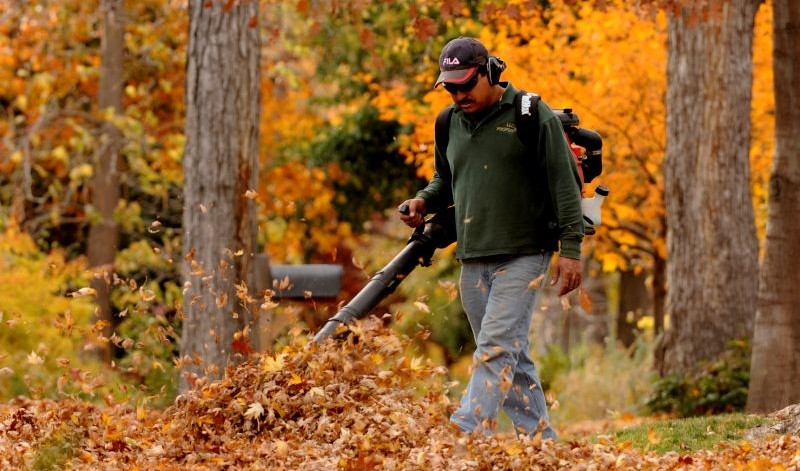
Electric alternatives have improved substantially, and the consumer price differential of gas-powered equipment has narrowed. While the political and legal terrain is growing more contentious and complicated, the underlying case for regulation is more powerful than ever. Consider that a consumer-grade, two-stroke gas-powered leaf blower emits more pollution in 30 minutes than a Ford F-150 Raptor traveling 3,900 miles from Alaska to Texas.
Two-stroke engines—the technology underpinning gas-powered leaf blowers—have been phased out of virtually every other industry due to their debilitating impacts on worker health. Yet two-stroke engines remain commonplace in the landscaping industry, raising enormous environmental justice concerns, as half of all landscape workers nationally are Latino.
According to the 2020 National Emissions Inventory published by EPA, lawn and garden engines emit nearly 22,000 tons of fine particulates into the air—as much pollution as produced by 234 million cars annually.
The noise pollution alone from gas-powered blowers is staggering. Gas-powered blowers routinely exceed 100 decibels, equivalent to standing beside a jet engine at takeoff. Permanent hearing loss begins at 85 decibels. These harms are concentrated and borne disproportionately by low-wage workers and neighbors who have little practical recourse.
Several state and local governments have acted since 2023. California enacted the most sweeping action: a statewide ban on the sale, though not the use, of all new gas-powered lawn equipment, effective 2024. Virginia is a Dillon’s Rule state where local governments have only the powers explicitly given to them by the state. There, the Virginia Attorney General issued a legal opinion in 2024 granting localities the authority to amend noise ordinances to prohibit gas-powered leaf blowers. Soon after, Alexandria, Virginia, voted to phase out gas-powered leaf blowers in favor of electric equipment. In July 2025, Montgomery County, Maryland, banned the use of gas-powered leaf blowers, with a violation resulting in a $500 citation.
City-level action has also accelerated. Portland, Oregon voted unanimously in 2024 to phase out gas-powered leaf blowers starting in 2026, with a complete ban by 2028. Seattle banned contractor use by 2025 and homeowner use by 2027. Baltimore enacted an ordinance restricting gas blower use to a two-month fall window, with a full ban taking effect at the end of 2026. Lexington, Massachusetts, enacted a commercial ban effective March 2025, with residential use to follow in 2026.
State governments are acting as well. Colorado prohibited state agencies from using gas-powered push and handheld lawn equipment during summer months beginning in June 2025. The law also requires the University of Colorado to report annually on gas equipment use to the state Air Pollution Control Division.
This regulatory momentum has also stimulated a coordinated countermovement. Landscaping industry groups have partnered with state legislators in Texas in 2023, in Georgia in 2024, and in Florida in 2026 to enact preemption laws prohibiting local governments from banning gas-powered equipment. The framing is familiar: Local restrictions, the argument goes, impose unfair burdens on small businesses. But these preemption laws reallocate regulatory authority away from the governments most directly affected by noise and localized air pollution. Communities experiencing the harms lose the ability to tailor regulations to local conditions.
Georgia enacted a law in 2024 preempting local governments from imposing a ban on gas-powered lawn equipment. This legislation strips Atlanta and other Georgia municipalities of the authority to address a demonstrable public nuisance within their own borders. For Atlanta, a city with a stunning tree canopy that is known as a “City in a Forest,” the “ban on bans” legislation is particularly incongruous and harmful.
The backlash has also arrived in court. In 2023, a group of landscaping companies sued Montclair Township, New Jersey, after the township enacted a gas-powered blower ban, arguing that the ban violated the U.S. Constitution’s Takings and Supremacy Clauses, and the U.S. and New Jersey Constitution’s Equal Protection Clause. Although a federal district court dismissed this claim and the U.S. Court of Appeals for the Third Circuit upheld the decision, the litigation demonstrates the extraordinary steps that vested interests will take to challenge leaf blower regulation.
Litigation may be beginning to move in the other direction—a “backlash to the backlash.” Homeowners in some jurisdictions may consider bringing nuisance claims against landscaping companies under state law. Georgia nuisance doctrine, for instance, defines a nuisance as “anything that causes hurt, inconvenience, or damage to another”—without regard to whether the underlying act is otherwise lawful. Given that gas-powered blowers routinely exceed 100 decibels, nuisance law offers a plausible theory of liability and takes on increased importance as state legislators prohibit municipal action. But litigation is a costly and unpredictable substitute for regulation, and any relief would be ad hoc at best.
In the interim, I assess that three categories of actors can address the harms of gas-powered lawn and garden engines without waiting for Congress or state legislatures.
First, colleges and universities represent the most tractable near-term opportunity. Most large universities operate significant grounds maintenance programs, employ sustainability offices, and face competitive pressure from on campus environmental interests, including students, faculty, and staff, that reward emissions reductions. Here, the University of Southern California (USC) deserves special recognition. A letter from a professor to USC’s president put an end to gas-powered leaf blowers on campus over a decade ago, resulting in USC’s campus being certified as a “green zone” by the American Green Zone Alliance. USC remains one of the few major universities to have comprehensively phased out gas-powered leaf blowers. The field appears wide open for other universities to act.
Second, state and local governmental officials can limit the use of gas-powered lawn equipment on state and local lands. For example, New York State’s Department of Environmental Conservation committed to converting its lawn maintenance equipment to zero-emission models. And Charleston, South Carolina, transitioned its city fleet entirely to electric and manual tools. More municipal and agency administrators can follow suit.
Finally, federal agencies have direct authority over the lands they manage. The National Park Service maintains iconic public properties and operates a substantial fleet of landscape maintenance equipment. An executive order directing federal land management agencies to phase out gas-powered equipment would generate real emissions reductions, signal a national norm, and require no legislative action. That such an order never came from the Biden Administration remains a missed opportunity. Meanwhile, federal regulation has remained limited to incremental emissions standards despite EPA’s authority under the Clean Air Act over nonroad engines. Although the current Administration is unlikely to pursue this authority, it remains available to future administrations. Imagine visiting Yosemite, Yellowstone, or the Grand Canyon without the fear of gas-powered leaf blowers disturbing your peaceful enjoyment.
The gas-powered leaf blower has become an unlikely but revealing test case for environmental regulation in an era of federal retreat. Some state and local governments have demonstrated the political leadership to act. The industry has responded with preemption campaigns and litigation. Congress and the executive branch have done nothing. What remains is a patchwork—regulations that are protective in California, prohibited in Georgia, and contested in a growing number of courtrooms.
Increasingly, the debate is no longer whether gas-powered leaf blowers should be regulated but who gets to decide—the federal government, state legislatures, local communities, or private litigants.
That patchwork will not hold indefinitely. The underlying harms to air quality, worker health, and to the peace of residential neighborhoods are irrefutable. The question is whether communities will continue to bear the costs while legislators stall in the face of industry opposition, despite mounting evidence of environmental and public health harms. Much as smoking on commercial aircraft now seems unthinkable, future generations may wonder why gas-powered leaf blowers remained commonplace long after their harms became clear.
The case for banning gas-powered leaf blowers is clear. The technology exists to begin their phase-out. The models are there to follow. The remaining question is no longer whether gas-powered leaf blowers should be phased out, but whether lawmakers are willing to overcome industry resistance and finish the job.