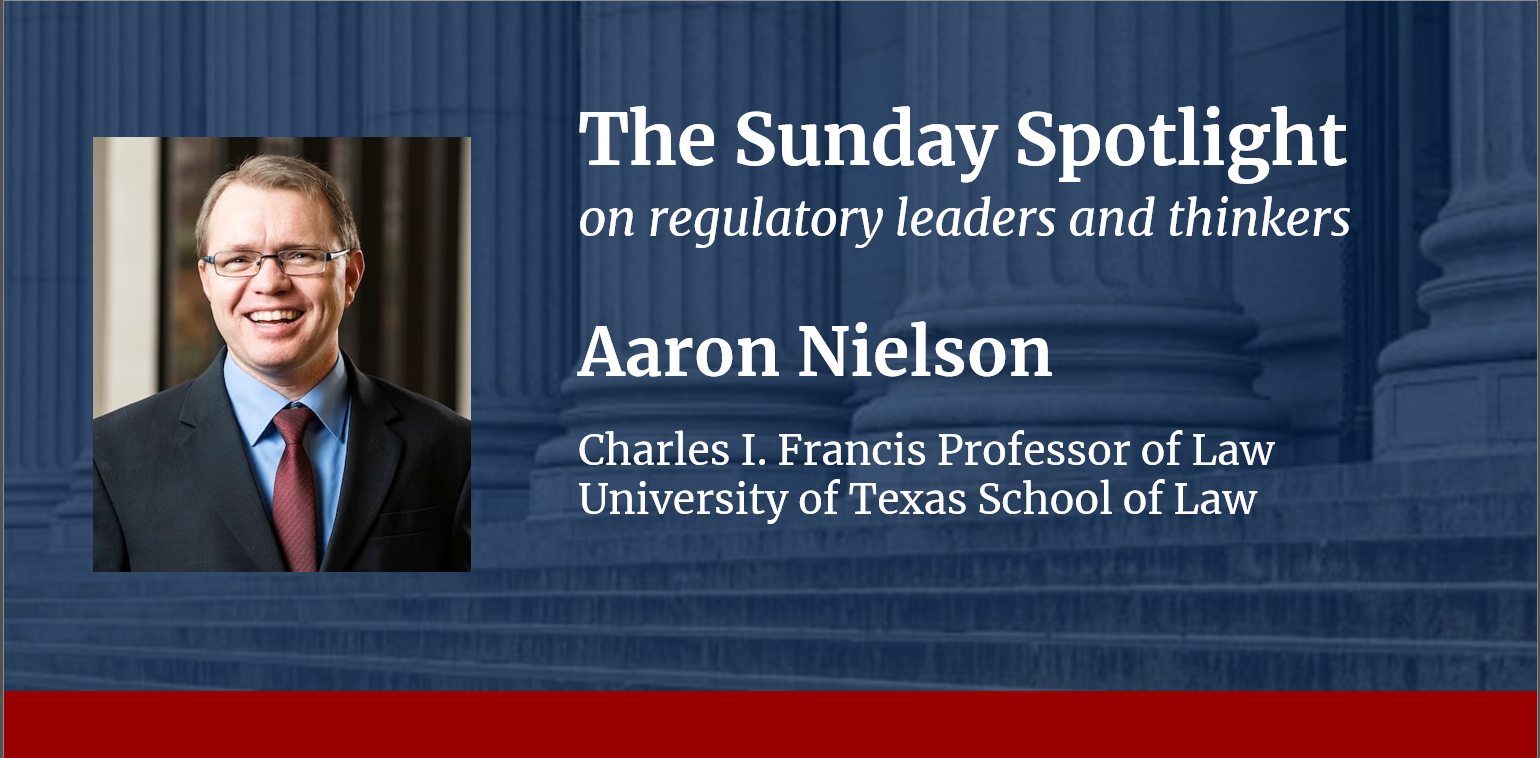
Aaron Nielson discusses the forces driving changes in the administrative state.
In a conversation with The Regulatory Review, Aaron Nielson, an administrative law scholar and experienced litigator, assesses the impact of recent shifts in administrative law doctrine and provides insights into the impact of these changes for the future of the administrative state.
In recent years, the U.S. Supreme Court has scrutinized the authority and independence of regulatory agencies. The Court has overruled the longstanding practice of deferring to reasonable agency interpretations of ambiguous statutes, imposed new limits on agency adjudication, and limited removal protections for certain government officials. As the Court continues to reconsider the scope of agency authority, scholars and practitioners face new challenges understanding how these changes will reshape the administrative state.
Nielson approaches pressing issues of administrative law with a perspective shaped by extensive experience in high-stakes appellate litigation. In evaluating current events, he promotes a view of the administrative state as a valuable, yet fallible, part of a system of government that needs reform. Nielson explains how his professional experiences have informed his perspective on federalism, allowing him to gain deeper insights into “the relationship between the States as sovereigns and the federal government as sovereign and the boundaries between them.” He identifies hurdles that the Trump Administration will have to navigate to advance a deregulatory agenda and predicts what the Supreme Court may do regarding removal protections for agency officials. He also advocates safeguarding agency adjudication from “misguided reforms.”
While serving as the solicitor general of Texas, Nielson oversaw appellate litigation for Texas and argued five cases before the U.S. Supreme Court. Nielson previously served as a professor of law at Brigham Young University while also serving as an appellate and antitrust partner at Kirkland & Ellis LLP. He clerked for Judge Janice Rodgers Brown of the U.S. Court of Appeals for the D.C. Circuit, Judge Jerry E. Smith of the U.S. Court of Appeals for the Fifth Circuit, and Justice Samuel A. Alito, Jr., of the U.S. Supreme Court.
Nielson holds the Charles I. Francis Professorship in Law at the University of Texas School of Law and is a partner at Kirkland & Ellis. In addition, he serves as a senior fellow of the Administrative Conference of the United States and an elected member of the American Law Institute. His research addresses administrative law, federal litigation, and the separation of powers.
The Regulatory Review is pleased to share the following interview with Aaron Nielson.
The Regulatory Review: You previously served as solicitor general of Texas and have argued multiple cases before the U.S. Supreme Court. How have these experiences shaped your understanding of administrative law and the role of administrative agencies and courts within the U.S. system of government?
Nielson: I was an administrative law professor for a decade before I left to serve as solicitor general, and before that I focused on antitrust and administrative law in private practice. So, when I served as solicitor general, it wasn’t like I was learning everything for the first time. Even so, it was eye-opening.
Most notably, my appreciation of and concern for federalism became stronger. I was already strongly committed to federalism before I started as solicitor general. Yet I became more aware on a day-to-day basis of the relationship between the states as sovereigns and the federal government as sovereign and the boundaries between them. Federal agencies and federal courts appreciate federal sovereignty but sometimes don’t fully appreciate that the federal government doesn’t have a monopoly on sovereignty. That is a problem. One of my favorite parts of being solicitor general was working with other states to defend state sovereignty.
TRR: You have referred to yourself as an “anti-administrativist” and expressed some concern about the scope of authority exercised by administrative agencies. What does it mean to be an anti-administrativist?
Nielson: I called myself an “anti-administrativist” a bit tongue in cheek because I don’t think it’s useful or accurate to draw categorical lines between those who think the administrative state can do no wrong and those who think it can do no right.
Who agrees with either extreme? So I defined anti-administrativism as the recognition “that the administrative state has value but … also is fallible and sometimes loses its way”—which is so expansive it should capture everyone. The world is complicated, and it is going to take a lot of hard thinking to build a system that works today. I’m not naïve enough to think that if we just all sit around in a big room, magically everyone will agree about everything. But I’ve been involved with the Administrative Conference of the United States for almost a decade, and as a team, we have helped identify reforms to address a very imperfect administrative state.
TRR: Recent Supreme Court decisions, including Loper Bright Enterprises v. Raimondo and Securities and Exchange Commission v. Jarkesy, have announced changes to doctrines that once afforded agencies significant discretion in statutory interpretation and enforcement. How has the relationship between the courts and agencies evolved in the wake of these decisions?
Nielson: To be determined. Immediately after Loper Bright—in which the Court overruled its decision in Chevron U.S.A. v. Natural Resources Defense Council providing for judicial deference to agency interpretations of ambiguous statutes—it sometimes felt like the U.S. Department of Justice believed that every statute contains an express delegation of interpretative authority. I don’t think courts are going to buy it. Pre-Loper Bright, I often invoked Abbe R. Gluck and Richard Posner’s 2018 article that surveyed federal judges and found that the real divide was not between judges appointed by Democrats or Republicans but rather between judges on the D.C. Circuit and other circuits. As Gluck and Posner reported, “all but one of the D.C. Circuit judges we interviewed—who were of different generations and political parties—were admirers of Chevron deference, whereas most other judges from the other courts of appeals were decidedly anti-Chevron.” It would be interesting to run that survey again in 2038.
As for Jarkesy—in which the Court held that agencies cannot adjudicate in-house certain claims for civil penalties because of the Seventh Amendment’s right to a jury trial—we haven’t seen the full effects yet. Courts have held some agency adjudications to be unconstitutional, but they have decided too few cases so far to assess Jarkesy’s impact. What’s next, moreover, may be further limits under Article III of the U.S. Constitution on agency adjudication of private rights.
TRR: In both his first and second terms, President Donald J. Trump announced major deregulatory goals. What legal hurdles must this or any Administration overcome to rescind or revise regulations?
Nielson: The State Farm doctrine. Under State Farm, agencies generally must satisfy the same “hard look” review requirements to eliminate a rule as to create a new one. I sometimes wonder whether it should be easier to get rid of a rule because new rules may have unintended consequences that are easier to see in hindsight than predict beforehand. On the other hand, I wrote an article called Sticky Regulations, which I expanded on in a subsequent article, Optimal Ossification. My theory was that if agencies could immediately change rules, long-term planning would be impossible for everyone. Richard J. Pierce, Jr., has made a similar point about how Chevron undermined long-term investment by making it too easy for agencies to zigzag.
TRR: The Supreme Court recently heard argument on whether to overrule its 1935 decision in Humphrey’s Executor v. United States and hold unconstitutional congressional limitations on the President’s ability to remove members of the Federal Trade Commission without cause. Will the Court overrule Humphrey’s Executor? If so, will it do so in a way that undermines Congress’s across-the-board power to make any multi-member agency independent, or will it take a narrower approach? Will the Court make any exception for the Board of Governors of the Federal Reserve?
Nielson: I think the Court will overrule Humphrey’s—or will at least read it so narrowly that it won’t apply to today’s Federal Trade Commission (FTC). That’s not a bold prediction. Justice Elena Kagan essentially said so in her emergency docket dissents. In fact, the Court’s 2020 analysis in Seila Law v. Consumer Financial Protection Bureau, which held unconstitutional a statute conferring for cause protection on the head of a single-headed agency, may compel that conclusion—just look at footnotes two and four. Moreover, after Seila Law, the Court decided a case called Collins v. Yellen. In Collins, the Court appointed me to defend the Federal Housing Finance Agency’s structure. Putting together the brief and preparing for oral argument in the middle of COVID-19 was an experience, but the Court didn’t buy arguments for limiting Seila Law.
Aditya Bamzai and I wrote an article about whether Congress can limit the President’s authority to remove members of the Board of Governors of the Federal Reserve. Recently, I also filed an amicus brief in Trump v. Cook to explain why the Federal Reserve raises unique questions because monetary policy was not considered a sovereign function at the founding, which is why the First and Second Banks of the United States were not hopelessly unconstitutional.
TRR: What would be the likely effects for agencies and for the nation if the Court overturned Humphrey’s Executor?
Nielson: That’s a great empirical question: How much policy independence do statutory removal restrictions create? Sometimes, at least for some agencies, it feels like not very much. Does anyone think in today’s world that the FTC chair chosen by the President, usually backed by two commissioners of the same party, is going to go too far beyond the President’s wishes? I mean, the chair of the FTC during the Biden Administration reportedly was on the campaign trail supporting her party in the run-up to the 2024 elections. So, in terms of assessing real-world effects, our focus probably should be on holdover officials—officials selected by a prior White House. Holdover agency leaders won’t be able to control agencies after Seila Law and Collins.
TRR: In a recent article, you and your coauthors (Christopher J. Walker and Melissa F. Wasserman) have advocated safeguarding the decisional independence of agency adjudicators. Why is the independence of agency adjudicators important, and what might threaten their independence today?
Nielson: To be clear, I don’t think agency adjudication as a category is beyond presidential control, especially because the Supreme Court has held that agencies may make policy through adjudication or rulemaking. Individualized fact-finding—such as determining when a disability occurred, however, can raise different types of considerations than policy control of an agency, but Article II of the U.S. Constitution may not draw a distinction. So, one threat could be Article II. But perhaps the more serious threat comes from misguided reforms. Almost all the proposed reforms likely will not solve the constitutional issue but will make agency adjudication worse.
So, what’s the answer? Chris Walker and I have published a couple of articles about what we call Congress’s “anti-removal power,” which explain how Congress—if it is willing to expend political capital—can create a measure of independence—what Alexander Hamilton called “stability of the administration”—without offending Article II. Such political tools should help safeguard individualized fact-finding, especially because Presidents generally are not keen on undermining it.