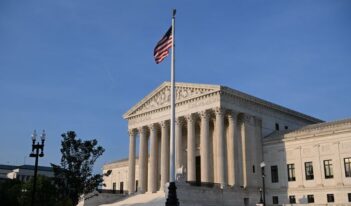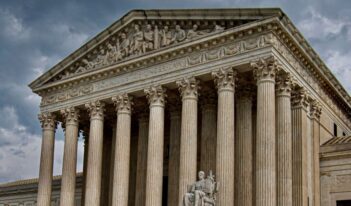

In Trump v. Barbara, the Justices’ arguments underscore their competing interpretive approaches.
In a fractured decision generating six opinions and 194 pages, the U.S. Supreme Court ruled that President Donald J. Trump’s executive order on birthright citizenship is unlawful. Pundits and experts expected the outcome but not how close the votes were: 5–4 on the constitutional question and 6–3 on the legality of the executive order. Trump v. Barbara will likely lead to continued and partisan debate. The opinion comes at a time that is of some predictable sensitivity and reflection for Americans. The 250th anniversary of independence from Britain makes Chief Justice John G. Roberts, Jr.’s, ode to citizenship especially poignant:
Citizenship, then and now, was the right to have rights—to freely participate in our political community. The Framers of the Fourteenth Amendment extended that promise to “every free-born person in this land.” … We keep that promise today.
The President’s order, “Protecting the Meaning and Value of American Citizenship,” sought to prospectively deny citizenship to the American-born children of unlawfully or temporarily present parents. And it did so by announcing a narrow understanding of the Citizenship Clause of the U.S. Constitution’s Fourteenth Amendment.
The Constitution itself is laconic: “All persons born or naturalized in the United States, and subject to the jurisdiction thereof, are citizens of the United States and of the State wherein they reside.” It is the second qualification of the Citizenship Clause— “subject to the jurisdiction”—that the President’s order purported to interpret and enforce.
And it is to that qualification that most of the Court’s pages were devoted. Chief Justice Roberts wrote for the five-person majority—including Justices Amy Coney Barrett, Elena Kagan, Ketanji Brown Jackson, and Sonia Sotomayor—and concluded that the order violated the Citizenship Clause. Justice Jackson wrote further, joined partially by Sotomayor, to challenge the principal dissent. Justice Brett Kavanaugh disagreed on the constitutional question, arguing instead that the order was unlawful under the Immigration and Nationality Act, which uses the same language as the Citizenship Clause. Justice Clarence Thomas wrote the principal dissent, joined by Justice Neil Gorsuch. Justices Samuel A. Alito, Jr., and Gorsuch also wrote separately.
Both as a historical and originalist matter, the Court was, in our view, correct. But this case tested both history and originalism. During oral argument, Solicitor General D. John Sauer urged the justices to remember that we now live in a “new world.” Chief Justice Roberts rejoined, calmly, “Well, it’s a new world. It’s the same Constitution.” Pithy as it may be, the comment did not generate much agreement about the Constitution.
In a decision of this length, it might be best to begin where everyone agrees. As Chief Justice Roberts explained, the Citizenship Clause overturned Dred Scott v. Sandford, the “odious decision” of 1857 that read into the Constitution “an unexpressed (and atextual) racial component” to the words “people of the United States” and “citizen.” Whether the Citizenship Clause only related to the citizenship of new freedmen or went further is disputed by the various opinions in Trump v. Barbara, particularly those of Justices Thomas and Jackson, respectively.
Most justices also agreed that the Citizenship Clause did not categorically deny birthright citizenship to the children of all people temporarily or unlawfully in the United States. As a facial challenge to the entirety of the order, Justice Thomas reminded his colleagues that “the plaintiffs bear the burden to show that all applications of the Order are unlawful.” Justice Thomas, who interpreted the Citizenship Clause to require “domicile,” would “reserve for another day the question whether the children of illegal aliens can be domiciled here.” Justice Gorsuch, agreeing with Thomas, saw some lawful applications of the order. He added, however, that “a child born here to parents who have long chosen to make this Nation their permanent home” may well be natural born citizens. Alternatively, Justice Alito interpreted the Citizenship Clause to exclude all children who would have dual or competing allegiances. Consequently, many children whose parents’ home countries did not impose the rights and duties of citizenship upon them would be citizens. Justice Kavanaugh, finally, would have recognized an exception to birthright citizenship. He understood the Clause to likely exclude citizenship for all “children born to foreign citizens unlawfully or temporarily in the country.”
The points of disagreement are many. Two predominate. First, the majority and dissents debated whether the common law of England, with its “feudal” history, is truly compatible with the American “settler ethos” and republican government. The dissents argued that, because the English rule tied subjects to land and to a king, America could not have inherited the rule of birthright citizenship. We have written extensively together, and both have written separately, about the common law’s relationship to citizenship. The inheritance of this common law tradition, as of many common law inheritances, is real, although it was modified to allow for American citizens to lawfully abjure or renounce citizenship. In England, the feudal rule remained that no birthright subject could expatriate himself. The dissents have much to say about how common law was antithetical to American ideals, but less to counter the contemporaneous evidence that the founding generation and ratifiers of the Fourteenth Amendment understood themselves to be maintaining a specific common law rule.
Second, and most importantly, the majority and dissents disagreed about the meaning of “subject to the jurisdiction.” The majority argued that the Citizenship Clause sought and was understood at the time of adoption to mirror and reinstate the common law that had been eclipsed by Dred Scott. At common law, Chief Justice Roberts explained, a child must both be born within the territory and subject to the sovereign’s governing power: “The Citizenship Clause uses jurisdiction in its ordinary sense—referring to the power of the United States to govern those within its territory.” He added that Wong Kim Ark v. United States, the key early case interpreting the clause, concurred. To the majority, a parent’s status has nothing to do with jurisdiction exerted over children. Arguments suggesting otherwise were both “revisionist” and wrong.
In Justice Kavanaugh’s view, “subject to the jurisdiction” meant to capture well-known exceptions to birthright citizenship, such as Native Americans, ambassadors, and enemy armies. Justice Kavanaugh would have rejected—and thus disagreed with the majority—that there was ever a “closed set” of exceptions to the birthright rule. For him, what is closed for the Constitution are “its principles.” Kavanaugh reasoned that “the original constitutional principles do not change absent a constitutional amendment, but the relevant principles—both the rules and exceptions alike—must be faithfully applied.” And the “only apparent principle unifying the four disparate exceptions … especially in light of the exception for tribal American Indians—is that the parents in all of those varied circumstances were not U. S. citizens and were citizens of other nations.” Kavanaugh compared this approach to the Court’s Second and First Amendment jurisprudence, but commentators were quick to point out potential nonoriginalist implications.
In examining the phrase “subject to the jurisdiction,” Justices Thomas and Gorsuch leaned into a concept found commonly in the realm of civil procedure: “A person was subject to the jurisdiction,” Justice Thomas explained, “of the government of his domicile.” And while it had many historic meanings, the “most common definition of domicile was residence with the intent to permanently remain.” Domicile impacted which governments may tax individuals and which marriage and property-law regimes applied to individuals, and it triggered various other mechanisms that tightened the relationship of a state or government and an individual. Justice Thomas argued that “the Citizenship Order is not facially unconstitutional … at least insofar as it applies to children born to parents, here lawfully or unlawfully, who are not domiciled in the United States.”
For Justice Alito, finally, the Fourteenth Amendment confers “citizenship on only those children who, at birth, owe allegiance solely to this country.” Interpreting the Civil Rights Act of 1866 and the post-ratification history of the Fourteenth Amendment, he concluded that “subject to the jurisdiction” means a kind of exclusive jurisdiction, a jurisdiction “not in any way limited by any power possessed by any foreign country.” Therefore, if a child’s parent’s country would claim the child as a national, such as under a jus sanguinis regime, in which citizenship derives from one’s parents’ citizenship rather than birthplace, that child would be denied citizenship by the Constitution.
These disagreements raise critical methodological questions for the historically minded lawyer and judge. The majority raised the alarm that the dissents rested upon “fundamentally revisionist scholarship.” Justice Thomas chided the majority for not properly dispensing with the evidence “that it characterizes as a revisionist project.” However these and other methodological snags might be best resolved, the implications are clearly dramatic.


This essay is part of a series titled, “The Supreme Court’s 2025-2026 Regulatory Term.”