
The Supreme Court considers presidential removal powers, U.S. Customs and Border Protection proposes social media disclosures, and more…
IN THE NEWS
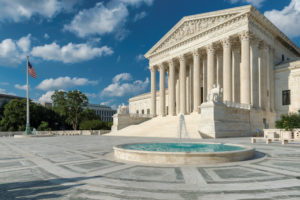
- The U.S. Supreme Court heard oral arguments in Trump v. Slaughter, a case expected by many to overturn a 90-year old rule that prevents the president from firing heads of independent agencies without cause. Under the current rule, which originated in Humphrey’s Executor v. United States, Congress can pass federal laws that prevent the president from firing leaders of independent agencies for reasons other than “inefficiency, neglect of duty, or malfeasance in office.” During oral arguments, the liberal justices warned that overruling Humphrey’s Executor could destroy the United States’ structure of government. The conservative justices, however, seemed skeptical about Congress’s constitutional authority to limit the president’s removal powers.
- U.S. Customs and Border Protection (CBP) proposed a rule that would require certain foreign tourists to disclose the past five years of their social media use prior to visiting the United States. The rule would also enable CBP to ask for visitors’ telephone numbers, email addresses, and IP addresses. Visitors from countries that fall under the Visa Waiver Program—that is, foreign nationals who do not need a visa to travel to the United States—are subject to this rule. In the proposal, CBP noted that this rule enables compliance with an executive order issued in June that calls for immigration restrictions aimed at ensuring that foreign nationals seeking to enter the United States “do not intend to harm Americans or national interests.”
- The U.S. Senate rejected two competing bills to extend Affordable Care Act subsidies expiring at year’s end, potentially raising premiums by 114 percent and increasing the number of uninsured individuals by 4 million. Democrats proposed a three-year extension of enhanced tax credits for 21 million enrollees, while Republicans advanced a plan redirecting funds to health savings accounts, capping eligibility at 700 percent of the federal poverty level, and restricting Medicaid coverage for gender transitions and abortions. Both measures failed to secure 60 votes in the Senate, highlighting partisan divides.
- The Trump Administration opened applications for the Trump Gold Card program, an expedited pathway to lawful permanent resident status available to immigrants who pay $1 million. Corporate sponsors of employees seeking this visa may apply for the Trump Corporate Gold Card by paying $2 million for each worker they sponsor. This launch follows an executive order issued in September directing the U.S. Department of Commerceto create the Gold Card program for those individuals who “have demonstrated their ability and desire to advance the interests of the United States.” The official application website for the Trump Gold Card also previews a potential Trump Platinum Card, which would permit foreign nationals to stay in the United States for up to 270 days without paying taxes on their foreign income.
- President Donald J. Trump shared his plan to sign an executive order blocking state artificial intelligence (AI) regulations this week. In a post on Truth Social, President Trump wrote that “there must be only one rulebook” if the United States is going to “continue to lead in AI,” and that the United States should not “expect a company to get 50 approvals every time they want to do something.” AI industry leaders, such as OpenAI CEO Sam Altman, have argued that a “patchwork” of state laws could slow AI innovation. Many academics, safety groups, and state lawmakers from both parties, however, worry that preempting state AI regulation may allow AI companies to avoid responsibility for harming consumers.
- The U.S. Food and Drug Administration (FDA) cleared Flow Neuroscience’s FL-100 headset as the first at-home, non-drug device for treating moderate to severe major depressive disorder in adults. The prescription wearable device, using transcranial direct current stimulation to target the brain’s prefrontal cortex, delivers gentle electrical currents in 30-minute sessions. A recent trial showed 58 percent remission after 10 weeks, with 77 percent of real-world users reporting improvements in three weeks and mild side effects such as skin irritation. Supporters praised the approval for expanding access to noninvasive therapy, potentially aiding millions unresponsive to antidepressants, while critics warned of limited long-term data and overreliance on self-reported outcomes, urging confirmatory studies. The device, already used by 55,000 individuals in Europe, will launch in the United States next year with insurance negotiations ongoing.
- FDA qualified LiverAI, an AI-based digital pathology tool, as the first such innovation for assessing liver biopsies in metabolic dysfunction-associated steatohepatitis (MASH) clinical trials. The tool automates measurements of fibrosis and inflammation, potentially accelerating drug development for a disease affecting 1.5 to 6.5 percent of U.S. adults. The European Medicines Agency followed with similar qualifications, emphasizing standardized, non-invasive evaluations. Supporters praised the milestone for enhancing trial efficiency and safety, while critics warned of overreliance on AI without robust validation, urging ongoing regulatory scrutiny.
- The U.S. Bureau of Reclamation announced changes to the federally managed Central Valley Project, a system of pumps, dams, and canals that transport water from northern California to the state’s agricultural Central Valley. The new plan would route more water toward farms and away from the Sacramento-San Joaquin River Delta, a critical habitat for fish such as salmon. This announcement followed an executive order emphasizing California’s need for a “reliable water supply.” The California Department of Water Resources criticized this move, noting that, if the federal Central Valley Project sends more water to farmers, the corresponding state water project will have to divert more water resources to species protection.
WHAT WE’RE READING THIS WEEK
- In a recent essay in the Yale Journal on Regulation, Jane Manners, a professor at Fordham School of Law, and Lev Menand, a professor at Columbia Law School, argued that, when Congress designates an officer to serve for a fixed term, that designation should be historically understood to provide protection from “at will” removal. They explained that the current understanding by lawyers and judges is that fixed terms are simply a “device to facilitate rotation in office.” Historically, however, legislatures throughout the nineteenth and twentieth centuries understood that “an officer serving a fixed term was widely and uncontroversially understood to be unremovable prior to the end of their term.” Manners and Menand explained this misunderstanding stems from a repeated misreading of Parsons v. United States. They concluded that, when the U.S. Supreme Court decides current presidential removal cases such as Trump v. Slaughter and Trump v. Cook this term, it has a chance to “set things right.”
- A recent report from Public Policy Solutions examined how European protectionist digital regulations, including taxes and AI rules, are spreading to Latin America and targeting U.S. tech firms with fines and probes while favoring Chinese competitors such as Huawei, a technology company. The report argued that nations such as Brazil and Colombia are adopting these policies, enabling Chinese Communist Party-linked infrastructure dominance and threatening U.S. economic leadership. The report highlighted risks to regional security from Huawei’s 70 percent market share in 4G networks. It recommended enforcing trade deals banning discriminations, limiting Chinese data access, and promoting open markets to counter regulatory capture and preserve innovation.
- A recent report by the U.S. Government Accountability Office (GAO) examined the progress made by the U.S. Small Business Administration (SBA) in implementing earlier GAO recommendations to address fraud risks, better estimate improper payments, and manage its contracting programs. GAO observed that the SBA had assessed fraud risks and developed a strategy to mitigate them, but was lagging in taking other steps such as identifying applicants who had attempted to defraud the SBA multiple times and developing a better plan to refer cases of fraud to the SBA Office of the Inspector General. Although the SBA has estimated improper pandemic relief payments, GAO pointed out that SBA had not complied with requirements set out by the Office of Management and Budget to review payment programs in fiscal year 2024. GAO also found that SBA has improved documentation of contract compliance reviews and began to submit an annual report, but has not yet implemented GAO’s recommended risk management procedures.
EDITOR’S CHOICE
- In an essay in The Regulatory Review, Bernard W. Bell, a professor at Rutgers Law School, discussed the “appointment and removal litigation ecosystem”—a set of doctrines that determines the right to make challenges, and the remedies available, in presidential removal cases. Bell explained that appointment and removal cases are usually not brought by the official who has been removed or even by the executive branch. As a result, Bell argued that cases such as Collins v. Yellen—which clarified standing requirements and remedies—have major implications for those seeking to challenge presidential removal cases. Bell concluded that cases such as Collins “broadly limit” the use of “for cause removal” to protect agency heads.