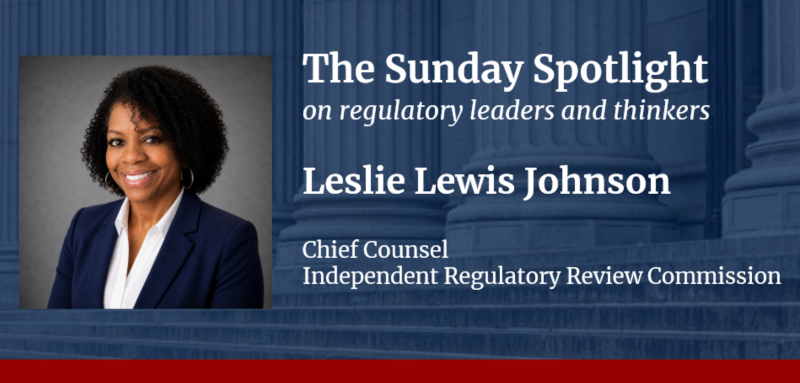
Leslie Lewis Johnson discusses public engagement in Pennsylvania’s regulatory review process.
In a conversation with The Regulatory Review, Leslie Lewis Johnson, chief counsel of Pennsylvania’s Independent Regulatory Review Commission (IRRC), discusses the role that independent review plays in Pennsylvania’s regulatory process and explains how the public can participate in shaping regulations.
In this spotlight, Johnson discusses how IRRC reviews proposed and final regulations to determine whether they are in the public interest. She also discusses how IRRC’s independence from the governor’s office allows the Commission to evaluate regulations without direct political influence. Johnson shares how IRRC engages with the public by hosting seminars on the regulatory process, meeting with groups and individuals who may be affected by regulations, and livestreaming meetings to the public. Drawing upon her experiences at IRRC, Johnson provides suggestions for increasing the public’s knowledge of and engagement in the rulemaking process.
A graduate of the University of Pennsylvania Carey Law School, Johnson has served as IRRC’s chief counsel for 19 years. She previously practiced business and corporate law and served as legal counsel to several public universities in Pennsylvania.
The Regulatory Review is pleased to share the following interview with Leslie Lewis Johnson.
The Regulatory Review: What is IRRC, and what role does it play in the regulatory development process in Pennsylvania?
Johnson: In 1982, the Regulatory Review Act created IRRC to provide independent oversight of the rulemaking process in Pennsylvania. IRRC helps the Governor, Attorney General, and General Assembly with their oversight functions by providing a comprehensive impact analysis of proposed and final regulations, creating a forum for public input and access to regulatory materials, and encouraging the resolution of issues.
The rulemaking process starts at the agency level where it lays the groundwork for developing a new regulation or revising an existing one. Each agency has its own internal procedure for how this is done. It can take weeks, months, or years before an agency is ready to publish a proposed regulation in the Pennsylvania Bulletin—a weekly publication containing notices of proposed regulations—and open the regulation to public comment. Before publication, executive branch agencies must receive approval from the Governor’s Policy Office, the Offices of the Budget and General Counsel, and the Office of Attorney General. Once the regulation is delivered to the Legislative Reference Bureau, IRRC, and the legislative standing committees, the formal regulatory review process begins.
The agency has two years from the close of the public comment period to deliver a final-form regulation to IRRC and the standing committees. IRRC has no less than 30 days in which to take action on the regulation at a regularly scheduled public meeting to determine whether it is in the public interest. The majority of regulations are approved by IRRC. Once that takes place and if there is no statutory need for the standing committees to undertake further review—such as in the event of an IRRC disapproval—the agency will submit the final-form regulation to the Office of Attorney General for approval prior to final publication. Under certain parameters set forth in the Act, IRRC may also review an existing regulation to determine if it is still in the public interest.
TRR: What does it mean that IRRC is an “independent” agency, and how does that independence affect the regulatory review process?
Johnson: IRRC is not part of the executive branch and is not subject to the policy or control of the Governor’s Office. Its day-to-day operations are run by an executive director, who is appointed by the Commission, which consists of five commissioners. Four of the commissioners are appointed by the four legislative caucuses who serve for a term of three years. One commissioner is a gubernatorial appointee who serves at the pleasure of the Governor. A commissioner may not be a Commonwealth employee or hold an elected or appointed position in state government. The commissioners can determine whether a regulation is in the public interest without direct political influence.
TRR: What are the most important factors that IRRC considers when reviewing proposed regulations?
Johnson: Section 5.2 of the Regulatory Review Act has a set of criteria that the Commission must consider when reviewing a regulation, both proposed and final, to see if it is in the public interest. The most important criteria are whether the agency has the statutory authority to issue the regulation and whether the regulation is consistent with the intent of the General Assembly. Additional criteria that the Commission must consider include:
- Economic and fiscal impact on the public and private sector.
- Protection of the public health, safety, and welfare.
- Clarity, feasibility, need, and reasonableness of the regulation.
- Whether the regulation is supported by acceptable data.
- Whether a less costly or less intrusive alternative method has been considered for small businesses.
- Comments, objections, or recommendations made by a legislative standing committee.
When considering whether a proposed regulation satisfies these criteria, IRRC’s regulatory analysts review all written comments submitted, conduct independent research, and provide outreach to the public and affected parties. IRRC does not take action on proposed regulations, but within 30 days of the close of the public comment period, it may issue written comments to the agency based upon the criteria set forth in section 5.2 of the Act.
The agency has two years from the close of the public comment period to deliver a final-form regulation to IRRC, taking into consideration all comments raised at the proposed stage. The final-form regulation will be placed on IRRC’s public meeting agenda, where the commissioners will determine whether it is in the public interest by voting to approve or disapprove it in its entirety. The Commission’s scope of review is limited to comments, recommendations, or objections raised by IRRC at the proposed stage, changes made from the proposed to the final stage of the regulatory process, and recommendations, comments, or objections raised by a standing committee.
An IRRC disapproval merely delays the process for issuing a final-form regulation. Only the General Assembly can permanently bar publication of a regulation.
TRR: How has IRRC supported making the regulatory review process more transparent for the public over time? For example, does IRRC itself solicit public input on proposed regulations?
Johnson: Before the Regulatory Review Act, there weren’t many controls on the issuance of regulations in the Commonwealth. Very little analysis was put into considering the impact of a regulation on the regulated community, and even less effort was made to solicit public input. With the passage of the Act and its subsequent amendments, agencies must include information on their outreach efforts to affected parties in their rulemaking package.
Although IRRC does not solicit public input on proposed or final regulations, IRRC will notify potentially interested parties that a regulation has been delivered. Staff routinely answer questions about the regulatory review process and are willing to meet with individuals and groups to discuss the process in detail or to clarify any written comments they may have submitted. Depending upon the complexity of the proposed regulation or the level of public interest it has generated, IRRC may also encourage the agency to expand its outreach efforts and solicit additional comment prior to delivering a final-form regulation.
IRRC occasionally conducts seminars to demystify the regulatory review process. IRRC also has a website that includes links to regulations delivered in the last 25 years and all comments received. The site also includes a subscription feature that allows anyone to request alerts for all regulatory materials received by IRRC, a regulatory review process manual, and annual reports describing the regulations received each year.
At the public meeting, the Commission encourages interested parties to speak. Depending upon the nature of a final-form regulation, the chair may also explain part of the review process for the benefit of the public attendees. All meetings are livestreamed and posted to the Commission’s website for public viewing.
TRR: To what extent do you see public comments submitted on proposed regulations as shaping the final versions of those regulatory proposals?
Johnson: Public comments are often quite valuable in shaping final-form regulatory packages. This is especially true when the comments are detailed and tied to the criteria in section 5.2 of the Regulatory Review Act. The Act requires the agency issuing the regulation to review and consider all public comments received during the public comment period. At times, the agency will incorporate a comment into its final package, and sometimes it will not. The agency must respond to the comments, and if it disagrees with any of them, it must provide an explanation. Either way, this requirement results in a better final rulemaking package with either a revised regulation or a more comprehensive explanation of the agency’s position.
Written comments may also be submitted on final-form regulations, and comments may be made during the public meeting. If any objections raised during the meeting fall within the Commission’s scope of review, the Commission may issue a disapproval order with a recommendation to take such objections into consideration. Short of a disapproval, the Commission may also recommend that the parties engage in further dialogue once the process has ended to resolve any areas of concern. This can result in a new rulemaking package that is acceptable to everyone involved.
TRR: From your vantage point, what barriers do you see that keep more Pennsylvanians from engaging in the regulatory process? How could government agencies reduce these barriers to public engagement?
Johnson: One of the biggest barriers to public participation in the regulatory process is the perception that the process is confusing or time-consuming or that a regulation is too technically complicated to understand. Although agencies are required to publish all proposed regulations in the Pennsylvania Bulletin with a minimum 30-day public comment period, the average citizen may not be familiar with the Bulletin.
Some agencies schedule hearings or listening sessions around the Commonwealth for proposed regulations that might have a significant impact on large segments of the population. Perhaps the Commonwealth’s main webpage and each agency could run banners notifying the public of all proposed regulations, post such notices in their respective lobbies, or notify local news outlets.
Our educational system—including higher education—does a good job explaining how a bill becomes a law. However, there is very little discussion of the regulatory process and how regulations have the same force and effect as law. Public participation may increase if people knew that the regulatory process can be more accessible than the legislative process to the average citizen.
As previously noted, IRRC staff are always available to answer questions about the regulatory review process in general or provide general information on a particular regulation on its docket.
TRR: What inspired you to spend your career in public service, and what advice would you give law students or new lawyers who are thinking about working in state government?
Johnson: As with many things in life, my career in public service was neither linear nor intentional. My plan was to practice corporate law, and I took as many business-related electives at Penn as I could. After earning my JD, I spent three years practicing business and corporate law in a law firm based in central Pennsylvania. I unexpectedly found my way into higher education with the Pennsylvania State System of Higher Education, where I served as legal counsel for several of our public institutions, including Cheyney, East Stroudsburg, Kutztown, and West Chester University. Being a general practitioner in this setting provided me the flexibility to advise and represent each university in many legal areas, including contracts and procurement, labor and employment, civil rights, institutional development, and student affairs. I also established excellent professional relationships with each university’s senior management and its respective administrative departments and staff.
After 14 years in higher education, an opportunity arose for me to practice administrative law for another agency—IRRC. I was reluctant to leave the educational setting. However, I believed the move would provide a good opportunity to pivot from a broad, relatively fast-paced governmental practice to a more narrow, slower-paced one, especially with a young family to raise. Little did I know at the time that I would be in a position to develop a more comprehensive view of how state government works and gain a unique expertise on the rulemaking process with a small but exceptionally talented staff. This past April marks 20 years at IRRC, 19 as the chief counsel. I have not regretted it for a moment. This job has given me a greater appreciation for the number of hard-working, dedicated, and intelligent people we have working for the Commonwealth.
If someone had told me years ago that I would be reviewing regulations for a living and serving as a resource for both the executive and legislative branches of government, I probably would have laughed. Although it’s not something I anticipated coming out of law school, today I view my legal career as quite fulfilling and successful.
Taking all of this into consideration, my advice to law students is as follows:
- Continue setting career goals, but keep an open mind. Do not dismiss a professional opportunity outright because it does not check the right boxes or does not fall within your planned career path.
- Be willing to change jobs or sectors at least once or twice. I believe that working in both the private and public sectors can provide invaluable experience that can be useful in your career. On the other hand, if you find your dream job right out of law school, hold on to it, keeping in mind that your dream may change.
Talk to a mentor or faculty member, reach out to an attorney at a conference or bar association event, or check the directory of where you want to work and reach out to attorneys. You may be surprised to find that most, if not all, of us seasoned professionals are more than willing to speak with students and new attorneys and share our experiences.