
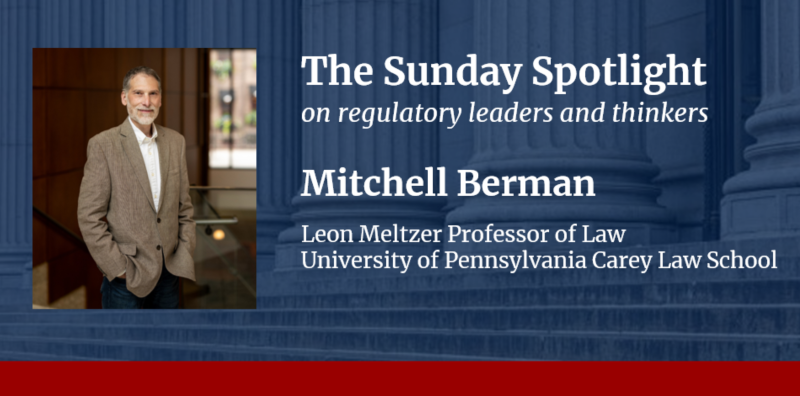
Mitchell Berman assesses sports as legal systems, discussing what sports can reveal about rules and regulation.
In a conversation with The Regulatory Review, Mitchell Berman offers a unique perspective on sports as an informative model for law and legal theory, and he explains what lawmakers and regulators can learn from analyzing sports as legal systems.
In this spotlight, Berman compares the study of sports as legal systems to a field of comparative law, encouraging legal scholars and practitioners to engage with sports on an intellectual level. He discusses comparisons between judges and baseball umpires, what sports can teach the public about the use of discretion in the enforcement of law, and the role of textualism in sports and law. As examples of these broader themes, Berman examines a curling dispute from the 2026 Winter Olympics and the use of video technology to review officials’ judgment calls made in sports.
Mitchell Berman serves as the Leon Meltzer Professor of Law at the University of Pennsylvania Carey Law School and the co-director of the school’s Institute for Law and Philosophy. He also holds appointments in the University of Pennsylvania’s Philosophy Department and in the Legal Studies and Business Ethics Department at the Wharton School. He is an award-winning professor and an expert in the fields of constitutional law and theory and the philosophy of criminal law, as well as a pioneer in the study of the jurisprudence of sport. He has published extensive scholarly research in prominent legal journals around the world and coauthored a textbook, The Jurisprudence of Sport: Sports and Games as Legal Systems, that introduces readers to a new and expansive field of comparative legal inquiry.
Berman previously served as the Richard Dale Endowed Chair in Law at the University of Texas Austin School of Law and as a law clerk for former Judge James Dickson Phillips, Jr., of the U.S. Court of Appeals for the Fourth Circuit.
The Regulatory Review is pleased to share the following interview with Mitchell Berman.
The Regulatory Review: In your textbook, The Jurisprudence of Sport, you explain that sports are not only enjoyable to play and watch, but also that they are worthy of serious intellectual attention. What can sports teach us about law and regulation?
Berman: The jurisprudence of sport starts from the idea that formal organized sports are, among other things, legal systems. Speaking very generally, sports, like municipal legal systems, use formal norms to facilitate, incentivize, and penalize human behaviors. Speaking more jurisprudentially, sports meld first-order rules of conduct and second-order rules regarding how to identify, create, and change those first-order rules of conduct—all administered by officials who accept those rules from the “internal point of view”—and thus qualify as legal systems under the influential standards of Hartian positivism.
In studying sports as legal systems, the jurisprudence of sport is a branch of comparative law. And as in any good comparative domain, illumination is not unidirectional. Just as sports can learn tons from ordinary law and legal theory, ordinary law can learn a great deal from sports. To ask what sports can teach lawyers and legal scholars is a little bit like asking what foreign legal systems can teach us about domestic legal systems: We can answer that question only by continuing to look.
TRR: During his confirmation hearing, Chief Justice John G. Roberts, Jr., of the U.S. Supreme Court compared judges to umpires, explaining that “umpires don’t make the rules, they apply them” to “make sure everybody plays by the rules.” How does the role of a judge compare to that of a baseball umpire?
Berman: As you may know, former Judge Richard Posner reacted to Justice Roberts’s line with incredulity. Neither Roberts “nor any other knowledgeable person,” Posner asserted, “actually believed or believes that the rules that judges in our system apply, particularly appellate judges and most particularly the Justices of the U.S. Supreme Court, are given to them the way the rules of baseball are given to umpires.” I’m with Judge Posner. Putting umpires aside, the notion that the justices of the Supreme Court are solely in the rule-application business is absurd. And revisiting Chief Justice Roberts’s quotation through the lens supplied by decisions he has since authored is beyond galling. Two recent decisions come immediately to mind: Trump v. Anderson, which held that states cannot restrict a presidential candidate from appearing on ballots, reserving that authority to Congress via affirmative legislation, and Trump v. United States, which held that the President has absolute immunity for core executive acts and presumptive immunity for official acts.
TRR: How much discretion are sports officials afforded in enforcing or interpreting rules? How does their discretion compare with the discretion given to legal actors, including regulators?
Berman: Sports are not monolithic. Soccer referees have vastly more enforcement discretion than baseball umpires do. The same is true of law. Police officers are invested with more discretion than clerks at the DMV; judges on trial courts and on the highest appellate courts have more discretion than do judges on intermediate appellate courts. So, I wouldn’t hazard any broad generalizations about either domain. But one lesson that close attention to sports officiating might teach is that “discretion” shouldn’t be considered a dirty word. Sure, discretion can be abused, but given the limits of human foresight a world in which all legal actors are divested of discretion would be dystopian. The task for a system designer is to limit and channel discretion, not to eliminate it.
TRR: During the 2026 Winter Olympics, the Canadian curling team was publicly criticized in a match against Sweden for allegedly breaking the rules to obtain an advantage, and some commentators claimed that “the whole spirit of curling is dead.” How should sports officials resolve conflicts between a sport’s underlying spirit and its enumerated rules?
Berman: Once again, I can’t offer you a one-size-fits-all answer, let alone one that would fit into this space. I’ll float three brief thoughts. Most significantly, many rules of many sports have long been interpreted and enforced in accord with something like the sport’s “spirit,” as against what an authoritative text says or means. In baseball alone, consider the famous pine tar game, or the phantom double play, or the disregard of the formal ban on fraternization. Anyone who believes that textualism is a general truth about law or legal systems should spend a little more time on the field, pitch, or court. Of course, the history of ordinary American law should be enough to disprove that canard, but some folks want to dismiss all counterexamples from American practice as mistakes. It is more obviously dogmatic to take that posture with respect to all of sport.
As far as curling in particular goes, two things. Less importantly, readers should know that the commentator who declared the spirit of curling dead was Marc Kennedy, the Canadian curler whom his Swedish opponents had charged with breaking the rules repeatedly. Kennedy was complaining about what he deemed a breach of norms against voicing accusations publicly. And although he might have had a modest gripe, the more fundamental truth is that the Swedish accusation was almost certainly correct: Kennedy did appear to touch the stone in violation of the rules and, worse, did not own up to it.
More importantly, it’s worth distinguishing two classes of sports officials—the “officiators,” who are usually called referees, umpires, or judges and who enforce rules in real-time—and the non-officiating officials, such as league presidents and commissioners, who exercise other responsibilities. I think you’re asking about officiators, reasonably enough. Note, though, that non-officiating officials also have a role to play, as when constructing the squad for international competition.
Marc Kennedy wasn’t the only Canadian curler at the just-completed Olympics who touched the stone illegally and denied it, vociferously and seemingly falsely. So too did Rachel Homan, skip of the Canadian women’s team. As the textbook you mentioned—co-authored with my friend and former evidence professor, Rich Friedman—discusses, Homan was criticized widely for violating the spirit of curling back in the 2018 Olympics. If the stewards of curling care to preserve its distinctive spirit, maybe officials who select athletes for national teams should make greater efforts to reward good sportsmanship and penalize bad.
TRR: After the recent Olympic curling incident, curling’s official governing body announced that it would not use video replays to review calls made by officials during games and would continue to rely on officials’ in-game observations. That approach can be contrasted with Major League Baseball’s decision to allow teams, starting this summer, to rely on automated ball-strike technology to challenge human umpires. What are your thoughts about sports replacing human decision-making with digital technology or rule enforcement? What might be gained or lost from increased reliance on video replays and “robotic” officials in the years to come?
Berman: There is an essential difference, in my view, between using video and similar technology to make calls in the first instance and using it to review calls made initially by human officiators. I favor both, in appropriate contexts, but the latter is significantly more fraught than the former, partly, but not only, for reasons concerning delay and disruption and the significantly adverse effect that reversals have on the emotional experience of sporting contests.
The main gains from either usage are increases in accuracy and, derivatively, in the justice of awarding results in accordance with desert. One loss that isn’t discussed enough concerns how technological enforcement of rules changes the way the game is officiated and thus played. For example, I have offered a couple of cheers for officiator discretion. But discretion is hard to marry to technological enforcement of rules, and a future of entirely “mechanical” or “robotic” rule-enforcement would be bleak indeed.