
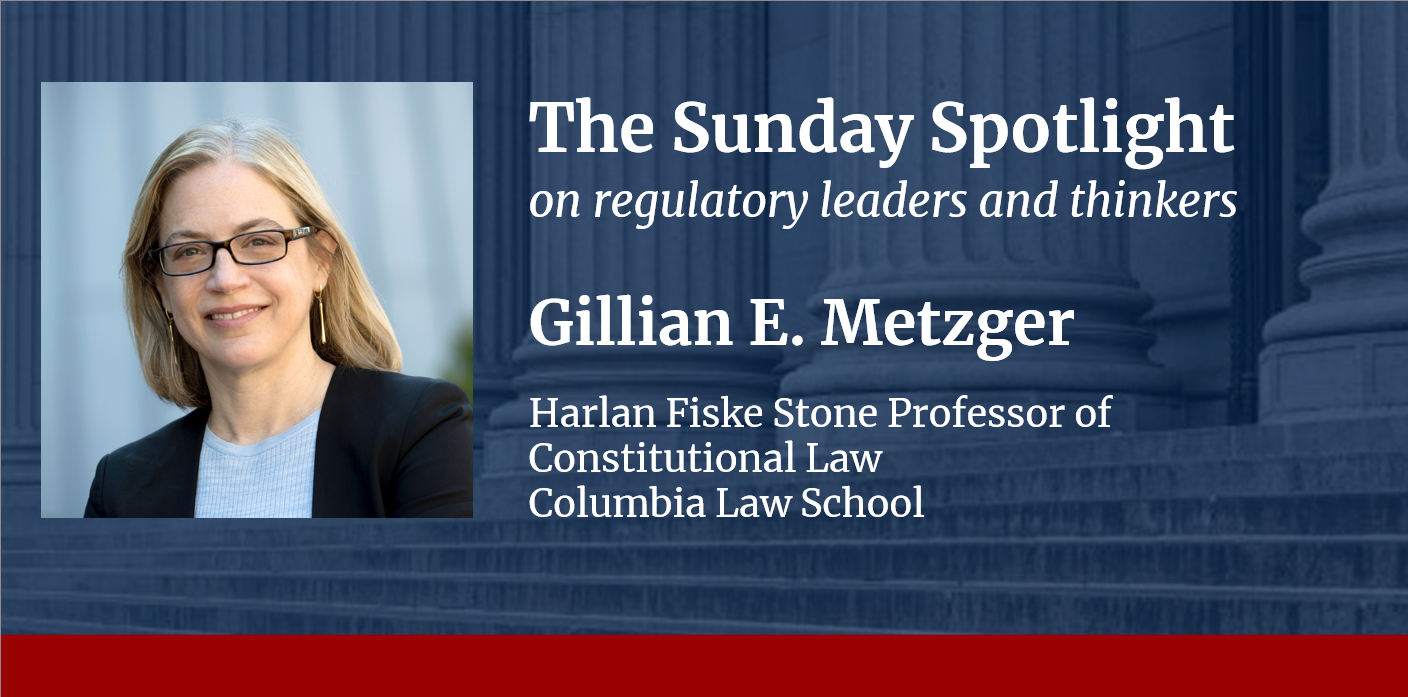
Gillian E. Metzger discusses how the U.S. Supreme Court has reshaped administrative law.
In a conversation with The Regulatory Review, administrative and constitutional law scholar Gillian E. Metzger discusses the impact of recent U.S. Supreme Court rulings on administrative law doctrine and the operation of federal regulatory agencies.
Many of the Supreme Court’s recent decisions have overruled longstanding administrative law doctrines. For instance, the Court has overturned the decades-long practice of judicial deference to agencies’ statutory interpretations, expanded the President’s ability to remove agency heads at will, and developed the major questions doctrine—under which a court will require a “clear statement” before concluding that Congress intended to confer authority on an agency to regulate on a matter of “vast” economic or political significance. These decisions, Metzger argues, reveal the Roberts Court’s “skepticism and distrust of administrative agencies.”
As the Court has limited the authority of administrative agencies, it has also expanded presidential power. In a recent decision, for example, the Court recognized broader presidential immunity from criminal prosecution, reasoning that the President alone holds the “entirety of the executive power.” Taken together, these decisions reflect what Metzger terms the Roberts Court’s “anti-administrativism.” According to Metzger, anti-administrativists “oppose administration and bureaucracy, but not greater presidential power.”
Metzger is the Harlan Fiske Stone Professor of Constitutional Law at Columbia Law School. Previously, Metzger served as acting assistant attorney general and deputy assistant attorney general in the Office of Legal Counsel in the U.S. Department of Justice. She currently serves as a senior fellow of the Administrative Conference of the United States and was elected to the American Academy of Arts and Sciences.
Metzger’s scholarship focuses on developments in administrative law under the Roberts Court and presidential control of administrative agencies. In 2016, the American Bar Association’s Section of Administrative Law and Regulatory Practice awarded Metzger its Annual Scholarship Award for her article The Constitutional Duty to Supervise. She is a co-editor of the administrative law casebook Gellhorn & Byse’s Administrative Law: Cases and Comments.
The Regulatory Review is pleased to share the following interview with Gillian E. Metzger.
The Regulatory Review: In what ways has the Roberts Court reshaped administrative law doctrine, and how has its approach differed from that of previous Courts?
Metzger: The Roberts Court has reshaped administrative law doctrine dramatically in a wide array of areas. Consider these four major moves, all occurring within the last five years: the Court’s 2024 rejection of judicial deference to agency statutory interpretations in Loper Bright Enterprises v. Raimondo; its 2020 invalidation of removal protection for single-headed agencies in Seila Law v. Consumer Financial Protection Board and strong suggestion that the Court will rule similarly with respect to multimember-headed agencies in its 2025 brief emergency docket case Trump v. Wilcox; its significant 2024 pullback on administrative adjudication in Securities and Exchange Commission v. Jarkesy; and its 2022 creation of the major questions doctrine in West Virginia v. EPA.
Many of these decisions overruled precedents that were longstanding staples of the administrative law canon: Loper Bright overruled the deference framework for agency statutory interpretations laid out in Chevron v. Natural Resources Defense Council, while Seila Law narrowed the Court’s 1935 decision in Humphrey’s Executor v. United States, and Wilcox suggests that decision will soon be cast aside entirely. Even aside from these results, the Roberts Court’s administrative law jurisprudence stands out for its skepticism and distrust of administrative agencies, its unwillingness to defer to congressional choices about how to structure government, and its seeming lack of concern with issuing decisions that disrupt decades of established administrative practice.
TRR: You have written extensively about what you call the “anti-administrativism” of the Roberts Court. What is “anti-administrativism,” and how did it manifest itself during the Court’s 2024-2025 term?
Metzger: I use “anti-administrativism” to refer to a constellation of views that manifest strong distrust and opposition to the federal administrative state, particularly regulatory and benefits programs. A prime example is the attack on the constitutionality of the administrative state that is ongoing at the Roberts Court. Importantly, anti-administrativists oppose administration and bureaucracy, but not greater presidential power. Thus, the Roberts Court has taken aim at independent agencies, administrative adjudication, deference to agency statutory interpretations, and agencies’ assertions of broad regulatory authority at the same time as it has granted the President broad immunity and removal power.
Anti-administrativism also takes political forms. It is evident, for example, in rhetorical attacks on an unaccountable deep state and recent actions to shutter some agencies and get rid of hundreds of thousands of civil service members. Here, too, we see anti-administrativism accompanying strong assertions of presidential power and targeted particularly at regulation, whereas law enforcement agencies are expanding.
Although anti-administrativism has made frequent appearances at the Supreme Court of late, it was more muted in the 2024-2025 term. Instead, there were a couple of important instances when a majority of the Court rejected formalistic attacks on administrative governance and upheld statutory regimes and longstanding precedent. One is the Court’s decision in Federal Communications Commission v. Consumers’ Research, where it rejected a nondelegation challenge to the “universal services” provision of the Communications Act of 1934, which requires that affordable communications services be made available to all Americans. In its ruling, the Court refused to overturn longstanding precedents upholding congressional delegation of authority to the executive branch, including tax authority, provided that Congress supplies an “intelligible principle” to guide executive branch decision-making. In another decision, Kennedy v. Braidwood Management, the Court rejected a challenge alleging that members of the U.S. Preventive Services Task Force were unconstitutionally appointed principal officers, who must be nominated by the President and confirmed by the U.S. Senate.
TRR: How might the Supreme Court’s anti-administrativist decisions affect the operation of regulatory agencies?
Metzger: The Court’s recent administrative law jurisprudence is having important effects on how administrative agencies operate. The major questions doctrine stopped key COVID-19 and student loan initiatives adopted by the Biden Administration. The Court’s precedent invalidating removal protections has had a significant impact on the agencies involved and set the stage for President Donald J. Trump’s second-term firing of Democratic members of independent boards and commissions. Although lower courts enjoined these removals, the Supreme Court’s emergency docket decisions staying those injunctions, such as Wilcox, allowed the removals to go forward.
In addition to significantly expanding the President’s control, these removals have served to deny many commissions the quorum they need to take certain actions. Decisions such as Jarkesy may curtail the ability of agencies to use administrative adjudication as an enforcement tool, although the decision’s full implications remain to be seen. It is still early in the new Loper Bright regime, but the loss of Chevron deference seems likely to have a significant effect on agencies’ ability to successfully defend their statutory interpretations at the court of appeals level, where Chevron deference had its biggest impact.
TRR: How has the Roberts Court redefined presidential power?
Metzger: The Roberts Court has espoused an expansive and strongly unitarian account of presidential power that holds that the President must be able to exert chain-of-command control over significant exercises of executive authority. The clearest manifestation of this has been the Court’s insistence that the President be able to remove agency heads at will. The Court also granted the President extraordinarily broad immunity in Trump v. United States, a decision that described the President as having exclusive authority over investigative and prosecutorial decision-making—a directive authority we have already seen President Trump asserting.
TRR: In its recent decisions, the Court has limited the authority of administrative agencies and expanded the scope of presidential power. Are these approaches inconsistent, and what do they reveal about the Court’s understanding of executive power?
Metzger: There is a notable contrast between the Roberts Court’s decisions on presidential and administrative power. Although the Court frequently takes an expansive view of presidential power, it often acts to restrict administrative—particularly regulatory—authority. This contrast is especially striking when the administrative agency’s action is one that is central to the President’s political agenda, which occurred in the Court’s major questions doctrine cases invalidating student loan cancellation, the Clean Power Plan, and COVID-19 vaccination and eviction initiatives. As some scholars have argued, such invalidation of prominent, presidentially directed administrative initiatives is in tension with the Court’s emphasis on presidential political accountability in its decisions expanding presidential power. That said, both features—a belief in strong unitary presidential power and a limited national administrative state—have long been two core components of the conservative legal and political agenda. Their shared appearance thus reflects the Roberts Court’s strong conservatism.
TRR: Looking ahead to the Supreme Court’s upcoming term, which cases do you anticipate will continue to shape administrative law and how?
Metzger: There are several cases on the Court’s docket this year that are of importance for administrative law. In Trump v. Slaughter, the Court considers the question of whether the Court will overturn Humphrey’s Executor and invalidate removal protection for principal officers who are members of independent boards and commissions. At issue in Trump v. Cook is the related question of what constitutes sufficient “cause” to remove a member of the Federal Reserve’s Board of Governors. And the Court may address the major questions doctrine and nondelegation in the case challenging the new tariffs, Learning Resources v. Trump. The Court’s emergency docket decisions often carry administrative law implications as well.
TRR: How did your service as the acting assistant attorney general and deputy assistant attorney general in the Justice Department’s Office of Legal Counsel during the Biden Administration inform your understanding of administrative law and executive power?
Metzger: My time in the Biden Administration was invaluable for the opportunity it gave me to see how administrative law and the federal government operate from the inside. One central lesson was the importance of internal forces—such as good executive branch lawyering and deep programmatic and scientific expertise—that help ensure the federal government wields its extensive powers lawfully and effectively. Unfortunately, these internal forces have been significantly weakened at the moment, with major losses of personnel at the Justice Department and across the executive branch, and a White House insistent on ever-broader assertions of presidential power.