
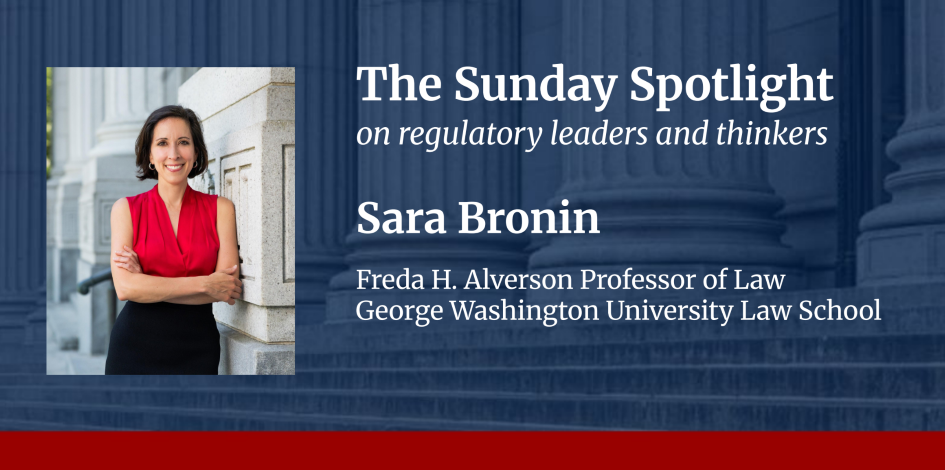
Sara C. Bronin examines how zoning and land use restrictions influence the growth and health of our communities.
Today marks the 100th anniversary of the U.S. Supreme Court’s opinion in Village of Euclid v. Ambler Realty Company, upholding an Ohio zoning ordinance that divided land into different classes of use. This decision paved the way for localities across the country to adopt comprehensive zoning and land use restrictions. In a conversation with The Regulatory Review, Sara C. Bronin discusses how these restrictions shape our communities.
Bronin argues that states should take a stronger role in overseeing local zoning decisions. She proposes that state legislatures set expiration dates for local zoning codes to require localities to ensure codes serve current constituents’ needs and emphasizes the importance of careful, thoughtful law and policy design.
Bronin is an architect and is the Freda H. Alverson Professor of Law at The George Washington University Law School. As one of the country’s foremost experts in property, land use, zoning, and historic preservation law, her work focuses on how law and policy can foster more equitable, sustainable, and connected places. She chaired the planning and zoning commission of Connecticut’s capital for seven years, leading efforts to overhaul its zoning code, and served as the Senate-confirmed chair of the Advisory Council on Historic Preservation, the independent federal agency charged with preserving the country’s historic places.
The Regulatory Review is pleased to share the following interview with Sara C. Bronin.
The Regulatory Review: What is one way that zoning laws shape a community that you think would surprise most readers?
Bronin: Despite zoning’s immense power, it remains largely unexamined by the people subject to it. Most zoning codes have not been comprehensively revised in decades, and few localities conduct regular reviews or initiate updates. As a result, the typical code is riddled with outdated, exclusionary, or arbitrary rules that have no relation to a community’s contemporary opinions about future growth. You see the consequences of this stagnation in the dominance of large-lot single-family zoning, a vestige of the postwar decades. Today’s zoning codes continue to prohibit other types of housing, along with the mixed-use neighborhoods that many people find desirable and convenient but were made illegal by postwar zoning. I critique this regulatory stasis in a forthcoming article, calling on state legislatures to establish sunset periods for local zoning codes. Only zoning codes that are interrogated and regularly updated can be said to shape a community in a way the community actually wants.
TRR: In addition to single-family zoning restrictions, local laws can impose public-hearing requirements and lot configuration, building size, and occupancy rules. Do these less visible restrictions tend to matter most for actual housing production? If so, how?
Bronin: A few years ago, I wrote about the collective impact of these arcane technical requirements in an article titled Zoning by a Thousand Cuts. They can make construction of multi-family housing either cost prohibitive or downright impossible—even where multi-family housing is technically permitted. For example, we’ve seen wealthy towns allow apartments but require three parking spaces for each unit—even studio apartments. What is the purpose of that provision, if not to exclude? Boston’s suburbs have played similar games when satisfying their obligations under a recent state law to permit multi-family housing near transit stops. As my research team has documented, some towns have imposed a one-acre minimum lot size or other onerous dimensional requirements, driving up the cost of housing development and undercutting legislators’ intent. So yes, these rules matter a ton, and reformers and policymakers have to pay keen attention to them, and not just stop at changing number-of-unit zoning permissions.
TRR: How should zoning reform fit alongside policies aimed more directly at the distribution of housing, such as subsidized housing, tenant assistance, or fair-housing enforcement? What problems is zoning reform particularly well suited to solve?
Bronin: Our housing crisis demands that we use every tool in our regulatory toolbox—and zoning is foundational to each one. Subsidies for housing and rental assistance, for example, can only be used when zoning allows affordable and accessible housing units to be built. For that reason, zoning reform must focus on increasing housing supply. The National Zoning Atlas reveals that across the United States, 62 percent of residentially zoned land allows only single-family housing, and 55 percent of single-family-zoned land requires minimum lot sizes of 40,000 square feet or more. Large lot sizes not only drive up home prices, but also force development to sprawl outward into farmland, forests, and environmentally sensitive areas. Communities have to start legalizing more types of housing, and removing those “thousand cuts,” such as parking mandates, that needlessly prevent units from being built and make them more expensive.
TRR: How should regulators take into account more intangible values such as neighborhood character, beauty, and history seriously without unduly subordinating competing or more quantifiable needs, such as access to affordable housing?
Bronin: Land use laws cannot just achieve practical aims: They must be written intentionally to facilitate places that people enjoy, find beautiful, and want to be in. So, drafters of zoning codes, historic preservation regulations, and subdivision ordinances must prioritize the human experience—including the deep human need to connect, create, and share in a sense of identity and a pride of place. How does this work in practice? It has to start with the belief that beauty, identity, and a connection to history are in many ways just as vital to the human experience as the need for shelter and food. That means the question of whether these values can be harmonized is not “if” but “how.” To take your example of historic preservation and affordable housing, regulators could advance both values by authorizing conversions of factories and offices for housing, legalizing accessory dwelling units in the historic neighborhoods that long accepted them, and protecting older buildings from needless demolition. Last year, we launched the National Preservation Atlas to improve policy discourse around preservation in particular. As it gets built out, I hope it can help us move away from false either-or choices and toward a vision for the law to create places that meet a full range of human needs.
TRR: What is the proper balance between local control and state intervention in land use law and policy?
Bronin: Almost two decades ago, I argued that states needed to launch a “quiet revolution” to reclaim their powers to improve local zoning approaches to environmental sustainability. Since then, a deeper understanding of the negative impacts of many zoning practices has only strengthened my belief that states must step in more frequently. That is because although zoning codes are written at the smallest level of government, housing markets, transportation infrastructure, and job networks span regions. States can address the scope-outcomes mismatch by compelling communities to consider the needs of workers and families who live beyond their borders but contribute to the same economies. And they can require localities to counter zoning’s longstanding legacy of segregation and exclusion, which endures in effect even if no longer explicit in zoning texts. Properly harnessed, zoning can open up opportunity, while creating beautiful, sustainable places. That is what I hope for zoning in its second century.