Margaret Kwoka maps FOIA trends and explores barriers to using FOIA to increase government accountability.
In a conversation with The Regulatory Review, Margaret Kwoka, a leading expert on the Freedom of Information Act (FOIA), identifies barriers to fulfilling FOIA requests and recommends reforms to FOIA processes.
Kwoka details her roots in government accountability research and practice. She explains that her early work revealed the varying motivations behind FOIA requests across commercial and private requesters. Kwoka connects her early research on FOIA motivations to current trends in FOIA requests. She explains why agencies often struggle to implement FOIA, and she suggests ways that agencies can address backlogs, delays, and excessive record withholding.
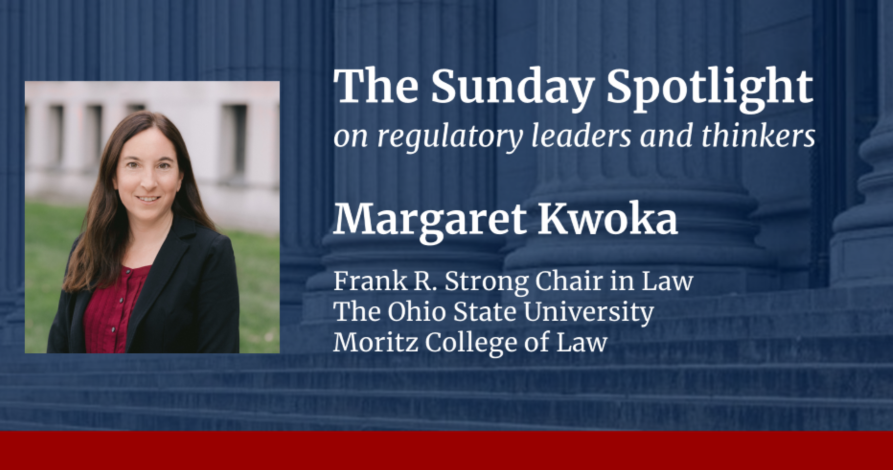
Kwoka has researched FOIA for over 15 years. As a leading FOIA scholar, she was a consultant for the Administrative Conference of the United States and a member of the FOIA Advisory Committee for its 2016 to 2018 and 2024 to 2026 terms. Scholars, agency officials, and legislators have sought her input on government accountability and transparency. She has twice testified on FOIA reform before the U.S. Senate Committee on the Judiciary. Kwoka is the Frank R. Strong Chair in Law at The Ohio State University Moritz College of Law, where she continues to research FOIA trends.
The Regulatory Review: What inspired you to focus your research on government transparency, accountability, and FOIA?
Kwoka: I found my FOIA passion by accident. As a newly minted lawyer at Public Citizen, a majority of my cases were FOIA cases, mostly representing other public interest group clients. Immediately I loved how these cases spanned a wide variety of issues I cared about from consumer safety to immigration reform to environmental protection. In each instance, it became clear that FOIA was crucial in accessing the government files these organizations needed to do their work. I was frankly in awe of the power of this seemingly humble law. When I became an academic, I threw myself into FOIA research. As a person who loves public institutions and wants government to be the best version of itself, FOIA is a piece of the accountability puzzle I am invested in helping to make work better.
TRR: In your article FOIA, Inc., you noted that, at some agencies, commercial entities “dominate the landscape of FOIA requesters” instead of journalists, watchdogs, and members of the public. 10 years later, is this still the case, and why?
Kwoka: Commercial entities are still responsible for a significant fraction of FOIA requests. But variation between agencies is enormous; some agencies are getting 80 percent or 90 percent of their requests from business, while others get hardly any. Typically, we are seeing most commercial requesting at agencies with large regulatory authority and those with a significant amount of government contracting. My sense from current trends is that the numbers of commercial requesters may not have changed much while the overall amount of requesting has skyrocketed. Rather than spikes in requests at agencies that receive business requests, we are seeing the greatest increases at immigration agencies, where nearly all requests are first-person requests, or requests where individuals seek government information about themselves. Of course, at individual agencies where commercial requesters make up the FOIA constituency, focusing on the needs of businesses as a way to improve FOIA administration is still a winning strategy.
TRR: What is the FOIA Advisory Committee, and how has your work as one of its members informed your approach to the field?
Kwoka: The FOIA Advisory Committee is a multimember body constituted by the National Archives and Records Administration that is made up of half government members and half nongovernment members—all with FOIA expertise—who come together to make recommendations for the improvement of FOIA law and administration. I have served two terms on the committee, and I have found the experience invaluable. The first benefit for me was the opportunity to learn from my government colleagues who serve as FOIA professionals in a variety of agencies, giving me a glimpse into the inner workings of FOIA administration I otherwise would not have. Second, the committee has given me a space to, working with others, translate some of my research into more concrete, actionable recommendations directed at both agencies and at Congress. This practical application of my scholarship has been extremely rewarding.
TRR: Backlogs and delayed responses are perennial issues under FOIA. What are the causes of these backlogs and delays, and how could they be addressed?
Kwoka: Backlogs and delayed responses are an intractable FOIA dilemma, but I do not believe that dilemma is unsolvable. A combination of three policy changes would go a long way to achieving deadline compliance. First, resources. For sure, I think FOIA offices need more resources in terms of staffing to clear backlogs, but resources can also allow a FOIA office to acquire better technology and to invest in longer-term programs, such as affirmative disclosures that hold the promise of easing the pressure on the individual request process. Second, FOIA needs to become the work of all agency personnel, not just the FOIA office. Changing the culture of agencies to understand FOIA as part of the fabric of agency work, not a compliance sideshow, is critical. Finally, government needs a FOIA champion, such as an information commission, with the power to provide government-wide assistance and leadership in this space.
TRR: Did the 2016 FOIA amendments improve FOIA processes, and what issues did they leave unresolved?
Kwoka: The 2016 amendments made some very important strides toward greater government transparency. Perhaps most notably, they added the “foreseeable harm” requirement that an agency not withhold a record under an exemption unless the agency “reasonably foresees that disclosure would harm an interest protected by an exemption.” This requirement is playing out in the lower courts and, although agency application of the standard is anything but consistent, requesters are winning some nontrivial victories to curb the broadest applications of the deliberative process privilege under FOIA Exemption 5 and the business secrecy protections of Exemption 4, in particular. Still, many agencies continue to interpret the exemptions extremely broadly, undermining FOIA’s maximum transparency aims, and exemption reform has been on requesters’ wish list for a while. Those involved in the next round of amendments should think seriously about limiting the over-withholding of records.
TRR: In your article First-Person FOIA, you noted a high demand for first-person FOIA requests. You argued that agencies could reduce that demand by simply expanding public access to government documentation. In the years since this article, have you seen agencies adopt this approach?
Kwoka: Happily, yes! There has been quite an effort in this regard, from recommendations from the advisory committee—in a term I was not serving—to an independently produced feasibility assessment at the U.S. Department of Homeland Security aimed directly at this question, to the U.S. Department of Justice requiring all agencies to report whether they have “established alternative means of access for any categories of first-party requested records” outside of FOIA. Some agencies have made drastic changes. The Justice Department’s Executive Office for Immigration Review, for example, now posts nonprecedential decisions online in the wake of a settlement, relieving individual requesters from the burden of asking for these decisions as a sort of “precedent-lite” to fight their own cases, and also provides a separate pathway to ask for a requester’s own “record of proceeding” or past administrative file. Still, many more opportunities exist, and it is great to see such momentum around the issue.
TRR: What has surprised you most in your FOIA research over the years?
Kwoka: I thought, as many people do, that FOIA was mostly used by journalists and watchdog groups. When I discovered all the private interests—both individual and commercial—being served by FOIA, it first struck me that FOIA might be largely serving unintended purposes. Although that may be true, I came to realize that studying these requesters reveals an entire relationship between the administrative state and its various constituencies, demonstrating what information the government has that people need. Once you lift the veil on these practices, it becomes clear that FOIA is an essential part of agency administration in a large variety of ways. And to the extent one might say it is not being used enough for democratic oversight purposes, we should concentrate on achieving those ends, rather than dismantling a transparency system whose tentacles touch nearly all of our lives.