
Scholars propose policies to govern the review of police body-camera data by artificial intelligence.
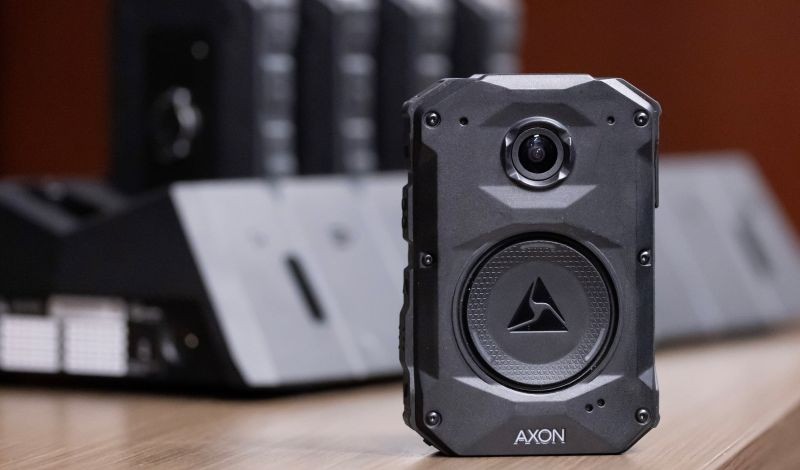
Following the police killing of Michael Brown in 2014, the U.S. Department of Justice supported the adoption of police body-worn cameras. Worn on an officer’s chest, these cameras record police interactions, providing an independent record of their interactions with members of the public. The cameras are also intended to create a psychological loop in which awareness of an objective observer helps deter aggression and encourage courteous conduct from both officers and civilians. The Justice Department initiative drove a surge in camera adoption. By 2020, roughly 79 percent of U.S. police officers worked in departments that used body-worn cameras.
This widespread use of cameras has produced more than 5,000 years’ worth of video. Manually reviewing more than a small fraction of that footage is practically impossible. Recently, however, several artificial intelligence (AI) vendors have developed tools to automate camera-data review. In a recent article, Vanderbilt Law School’s Farhang Heydari and several coauthors evaluate one such AI tool, Truleo, and use it to surface broader insights about AI-review platforms. Heydari and his coauthors offer policy recommendations to safeguard civil liberties, increase transparency and data availability, and maintain trust in the law enforcement system.
Truleo extracts audio from police camera footage and creates a transcript of police interactions with the public, separated by speaker. It then classifies interactions by type, such as traffic stops, stop-and-frisk encounters, or attempts by officers to de-escalate situations. It also parses police officers’ speech for the use of insults, threats, profanity, and the threat of force. When an officer’s language shows restraint and care in explaining the situation to civilians, Truleo’s system labels these interactions with various positive tags. Whenever an officer uses insults, threats, profanity, or the threat of force, Truleo marks the interaction as “pending.” Truleo relays pending items to police supervisors, who may apply a “follow-up” label or remove the flag from the review workstream.
In their article, the Heydari team warns that camera data could expand worrisome surveillance, especially in vulnerable neighborhoods and communities of color. They note that Truleo’s audio-to-text system minimizes the risk of abuse by removing identifying visual markers that would link body-worn camera data to police investigations. The Heydari team applauds Truleo’s design choices that limit surveillance risks, such as automatic personal information redaction and search limitations that prevent extensive cross-referencing between records.
Heydari and his colleagues express further concerns about the influence that police departments have over AI-review companies as their sole customers. They note that police associations are primarily concerned about their officers and have historically resisted efforts to increase police accountability and transparency through the use of body-worn cameras.
Heydari and his coauthors point to evidence that market pressure already shapes Truleo’s policies and design. They document a shift in Truleo’s marketing from a rhetorical focus on police accountability and building trust to one that promotes “police professionalism” and the building of police morale.
The Heydari team observes that Truleo’s design requires human intervention to apply certain negative labels, potentially limiting accountability. They contend that, as a direct result of pressure from police unions, Truleo reconfigured its system to suppress automatic supervisor notifications about officers with higher-than-normal negative interaction rates.
To prevent police departments from limiting access to body-worn camera data, Heydari and his coauthors urge municipal policymakers to ensure that the community owns data—not the police—and that meaningful third-party oversight is possible.
Heydari and his team flag wider limitations with AI analysis of camera data. They note that Truleo’s labels may miss the mark by prioritizing superficial criteria that do not necessarily imply good policing. Heydari and his colleagues provide the example of a pretextual stop, which may remain superficially professional and courteous, although it may have been motivated by unfair or illegal factors. They caution that Truleo’s current system would likely not flag polite yet impermissible police stops.
The Heydari team observes that positive labels may also anchor reviewers to a positive framing of police interactions, warping data and analysis. Similarly, they argue that police departments may be tempted to mischaracterize data by touting high or improving rates of positive tags as evidence of effective policing.
To prevent misuse of AI analysis of camera data, Heydari and his coauthors offer concrete guidelines for police departments and AI developers. They advocate adopting evidence-based labels and suggest that AI platform providers regularly test these categories against independent human control groups to verify accuracy. Heydari and his colleagues urge both agencies and vendors to provide the public with clear definitions of data classifications so that both the public and internal stakeholders understand what behaviors the system actually measures. They also recommend comprehensive training for all data users, focused on mitigating the impact of both the software’s inherent limitations and data users’ cognitive biases.
With protections in place, AI-enhanced camera data review can support meaningful law enforcement reforms, argue Heydari and his coauthors. They contend that agencies must secure public assent before implementing AI analysis of camera data, even suggesting that vendors should refuse to sell to departments that lack democratic buy-in. In addition, vendors should provide independent verification of any claimed benefits to maintain trust in the system. Heydari and his coauthors argue that transparency must extend to the design and operation of the technology itself. They recommend that companies clearly define their metrics and that police departments should be transparent about how they implement the software.
At a higher level, the Heydari team advocates outright municipal ownership of body-worn camera data or at least robust data-sharing policies to ensure that prosecutors and defense attorneys have ready access to valuable evidence. They add that broader sharing would also unlock the academic and reform value of body-worn camera footage archives by enabling independent researchers to analyze footage at scale and integrate it with other datasets to identify patterns and evaluate systemic interventions.