
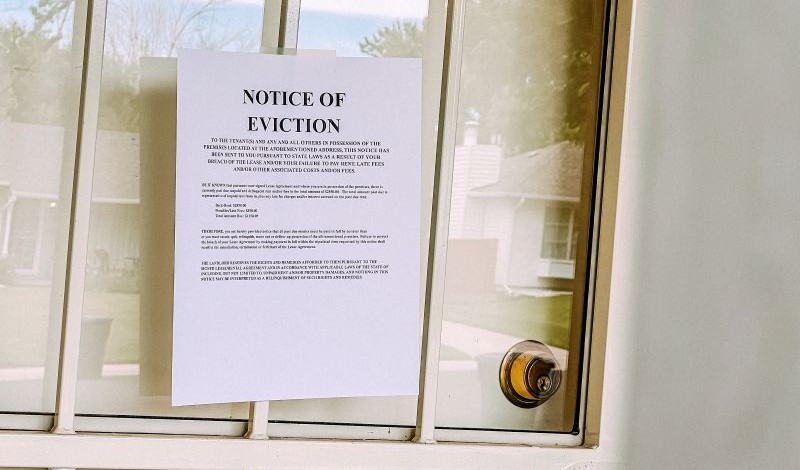
Scholars evaluate federal, state, and local housing policies aimed at addressing inequality.
Nearly half of American renters are considered “housing cost burdened,” meaning that they spend more than 30 percent of their family income on housing, according to a 2025 congressional report. More than a quarter of American renter households spend over half of their income on housing, and recent polling data shows that a majority of Americans think that housing costs are too high.
The housing affordability crisis is multidimensional: housing uncertainty can lead to physical and mental health problems, and marginalized groups face a disproportionate threat of eviction, which can entrench existing inequality.
Eviction filings are on the rise, and research shows that increases in the eviction filing rate are positively associated with increases in homelessness. Black and Hispanic renters, particularly Black and Hispanic women, disproportionately face the threat of eviction. Eviction exacerbates economic vulnerability by making it more difficult for renters to secure quality housing in the future. Compared to 7 percent of white renters, 19.5 percent and 14.5 percent of Black and Hispanic renters are behind on rent, respectively. Housing instability also harms children, who are more likely to fall behind in school and develop behavioral problems compared to their peers with stable housing.
In the United States, tenant law operates on federal, state, and local levels. At the federal level, the Department of Housing and Urban Development (HUD) administers the Fair Housing Act (FHA), which prohibits discrimination in the leasing and sale of housing. Biden administration policymakers advocated the implementation of a new provision to the FHA aimed to address policies such as tenant screening on the basis of eviction history, a practice that disproportionately harms renters of color. But under the Trump Administration, HUD announced that it would terminate the rule. HUD also recently proposed a 40 hour work requirement for recipients of rental assistance, a move that experts warn could place as many as 3.7 million Americans at risk of losing their benefits.
States and municipalities vary in how they regulate rental housing, meaning that renters’ rights differ across states and cities. Specifically, state statutes, local ordinances, and judicial decisions govern policy concerning habitability, eviction procedure, and rent control. Ten states and Washington, D.C. have adopted “just cause” eviction laws, which require landlords to cite a specific, verifiable reason before evicting a tenant. A growing number of states have adopted programs providing legal counsel to tenants facing eviction. In 2025, six states introduced bills addressing the habitability of rental housing.
Amid rising housing costs, policymakers and scholars disagree on the best approach to ensuring housing stability and protection for U.S. renters.
In this week’s Saturday Seminar, scholars examine the interaction of federal, state, and local housing policy aimed at promoting access to affordable, habitable housing.
- In an article in the Journal of Urban Economics, Edward Coulson of the UC Irvine Paul Merage School of Business and several coauthors analyze how landlord-tenant regulations shape housing markets. The Coulson team finds that stronger eviction protections reduce eviction rates but increase rents and homelessness. Stricter rules raise landlords’ costs, which may be passed onto tenants through higher rents and reduced housing availability, Coulson and his coauthors explain. They emphasize that because landlord-tenant law is largely governed by state statutes, which themselves are often influenced by model legislation such as the Uniform Residential Landlord and Tenant Act, policymakers must design these rules carefully to balance tenant protections with housing affordability.
- Noah Kazis of University of Michigan Law School assesses the FHA’s potential to address the inequitable structure of America’s housing system in an article in the Virginia Law Review. Kazis compares the FHA to Title VII, a parallel law enacted to address employment discrimination; Kazis contends that the FHA defines “discrimination” broadly, recognizing the distinctive features of housing discrimination and housing markets. The FHA also takes a distinct structural approach that contemplates more than police individual housing transactions, including its protection for consumers attempting to obtain additional qualifications needed to secure their desired housing, Kazis notes. Although Kazis emphasizes the Act’s potential, he also acknowledges that it has fallen short of its ambitious purpose in practice.
- A 1985 Washington Supreme Court decision that removed tenants from the protection of the Consumer Protection Act undermines the state’s consumer protection framework, argues Robert Colton of the University of Washington School of Law in a Washington Law Review article. Colton emphasizes the asymmetry of Washington’s housing laws, which provide expedited tenant eviction proceedings for landlords, but offer flawed, impractical remedies for tenants facing unsafe conditions or landlord misconduct. The Court’s decision in State v. Schwab exacerbated this inequality by removing a powerful legal avenue for tenants to seek redress, Colton contends. Colton calls for the Court to overturn Schwab to ensure that consumers engaging in residential landlord-tenant transactions receive the same protections they get in other consumer contexts.
- In an article in Housing Policy Debate, Margaret Hagan of Stanford Law School and several coauthors argue that the federal government does not need new legislation to improve housing stability. Instead, HUD can rely on its existing authority to influence state and local housing policies, the Hagan team explains. For example, the authors propose that HUD can promote stronger tenant protections by conditioning funding on local governments banning discrimination against renters who use housing vouchers. The authors also highlight practical steps to advance housing equity, including expanding eviction prevention programs and adopting policies that give renters more time and support before eviction proceedings begin.
- The law fails to integrate housing accessibility and habitability, argues Mitch and Tessa Henson of the University of Wisconsin School of Law in an article. They contend that, as a result, current housing law fails to promote equal access to habitable housing. Mitch and Henson present housing reforms made in Madison, WI as an example of a successful effort to promote habitable housing. In addition to robust state level enforcement measures, the city of Madison can sue rental property owners who violate building codes, and a local ordinance enables renters to withhold rent when their homes have uncorrected housing code violations, Mitch and Henson explain. They advocate similar reforms across the United States.
- Chicago’s complaint-driven enforcement system leaves dangerous housing conditions unaddressed, which disproportionately harms low-income renters, argues Sarah Tseggay of Yale Law School in an article. She proposes a citywide rental registry, which consolidates and publicizes property information, as a solution to underenforcement. Tseggay says that rental registries increase transparency, facilitate enforcement, and enhance tenant protections. She contends that a rental registry would promote public health. She explains that, in Chicago, over one million children are at risk of health complications from substandard housing conditions. Chicago’s crisis of housing habitability is compounded by decreased availability of affordable housing, Tseggay describes. A citywide housing registry, Tseggay maintains, would facilitate both housing code enforcement and holding landlords accountable.