
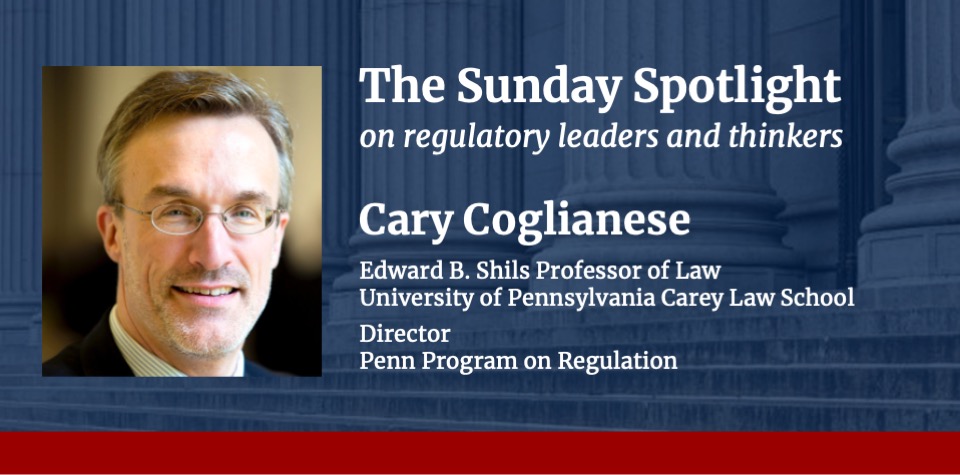
Cary Coglianese discusses how regulators can improve their performance in the face of pressing challenges.
In this edition of our Sunday Spotlight feature, Cary Coglianese explains that, during periods of rapid social, economic, and technological change, regulators need to keep at the top of their game. The core elements he has identified of regulatory excellence—the utmost integrity, stellar competence, and empathetic engagement—become vital for regulators to advance their important public missions. Coglianese maintains that, to practice empathetic engagement, regulators need to pay particular attention to the voices of the people who regulations are designed to protect.
The regulation of new technologies represents a current challenge for regulators because technological change is occurring rapidly. Coglianese argues that, in light of technological dynamism, regulators and the public need to recognize that thinking of regulation as “guardrails” often will not adequately capture what regulation needs to achieve. Rather than creating fixed boundaries that new technologies should stay within, regulators should often think about regulation as aiming to put leashes on new technologies, argues Coglianese. This better provides regulators and those they regulate flexibility in the face of rapid technological change.
In addition, Coglianese looks to the future of regulation in an era of increasing advances in digital technologies, such as development of artificial intelligence. He predicts that digital tools will assist regulators in important ways and that the use of artificial intelligence by government should be undertaken responsibly, adhering to the same core principles of integrity, engagement, and competence that characterize regulatory excellence more generally.
Coglianese is the Edward B. Shils Professor of Law, Professor of Political Science, and the Director of the Penn Program on Regulation at the University of Pennsylvania Carey Law School. He specializes in administrative law and regulatory processes. His research includes a wide range of issues in administrative law and regulatory policy such as climate change, artificial intelligence, public participation and open government, private standards, and the role of waivers and exemptions in regulatory law.
The Regulatory Review is pleased to share the following exchange with Coglianese, which is a lightly edited version of an interview conducted by Pieter Welp and Paulien de Winter that appeared earlier this year in the Dutch Journal for Supervision. Their interview was conducted during Coglianese’s visit to The Hague in November, 2025, where he delivered the keynote address at a major conference on “Future-Proof Regulation.”
Question: How should regulators approach their jobs in today’s rapidly changing world?
Coglianese: In a dynamic world, regulators need to be pursuing regulatory excellence in everything they do. Regulatory excellence means seeking to maintain the utmost integrity in what they do, seeking stellar competence, and seeking empathic engagement. To a large extent, those have always been the virtues of excellent regulation, but they become all the more important in periods of great flux in society. Flux in the world that regulators confront, whether through climate change or technological change, means new risks are arising. And this means that regulators need to be at the top of their game. Also, this need arises because society is much less trusting, and members of the public are able to scrutinize and criticize much more than in the past. In the past, regulators tended to operate in relative obscurity; it was sort of an engineering fraternity. Those experts within regulated organizations would interact with counterparts in the regulatory agency or body. They would talk to each other and work things out. Well, that’s not the world we live in today.
Question: Are you referring to regulators as the individual inspectors, the organizations, or both?
Coglianese: Both, definitely. An organization is only as successful as its members. A regulatory organization can fail just because one individual inspector overlooks a valve that needs to be looked at or forgets to measure an instrument that needs to be measured or monitored. That’s also true with respect to the regulated entities themselves and their organizations. It’s all about people at the end of the day. I think regulatory excellence is ultimately people excellence. And that means both the people within the regulated organization and the regulatory body. It is important to keep people at the heart of everything.
Question: Why is this so important for regulators?
Coglianese: I think it can be sometimes too easy for the people in regulatory bodies to forget who they are and what they are ultimately delivering in terms of value to society. Obviously, they have a lot on their plate. They have complex rules, complex organizations, complex science and engineering challenges that they’re all trying to understand and work through and ensure compliance with. It’s just easy sometimes to forget that what it’s all about really are people. And that manifests in terms of shaping the behavior of people. That’s what regulators do. And they do that to deliver outcomes for people—consumers, workers, members of the public. So, people are really at the heart of everything regulators do.
Question: Is that what you also mean by emphasizing “empathic engagement”?
Coglianese: By that I mean engagement with a wide range of people, certainly the people at the firms that are subject to regulation: engaging with them empathically, listening to them. Listening doesn’t mean agreeing, necessarily. But it means being open to the possibility of an agreement. It also means providing feedback and demonstrating that those being regulated have been heard. Research shows that when regulators do that, they actually build trust, and they can improve compliance.
That’s one part of empathic engagement. But another essential part of engagement is with the individuals that the regulations are designed to protect. The regulator needs to engage with these beneficiaries of regulation. Historically, they have had less voice and input into regulations, either in their making or their enforcing. So, special efforts may need to be made by regulators to
make sure that those voices are heard.
Question: How can regulators ensure that they pay attention to the voices of the people that regulations are designed to protect?
Coglianese: In some ways, I think it’s easier to do that today. We have better and easier communication technologies. Regulators operating today can generally provide a greater degree of transparency due to the internet. And with the social media environment and so forth, they can subject themselves to more public scrutiny—in a positive way. Regulators need to learn to use these tools for engaging with those who are affected by the outcomes of regulation. And that, to be honest, is the art of what I call the “molecule RegX,” which comprises the three atoms of utmost integrity, stellar competence, and empathic engagement. The atom, if you will, of empathic engagement is the one that I think is less intuitive for regulators. It’s been historically less part of what they do. And even today, when regulators are attending more to engagement, they may sometimes set up a separate office to handle this function. But in reality, empathic engagement is important throughout the whole regulatory organization.
Question: When we consider that “molecule” of regulatory excellence, where would you say we currently stand?
Coglianese: Regulatory excellence is not necessarily a state to which one attains and then declares “we’re excellent,” allowing an organization to rest on its laurels. It’s really a constant pursuit. I’m often asked, where are the truly excellent regulators around the world? I think there are many regulatory organizations that have excellent aspects of their operations. But it’s a little less important to say which ones are overall excellent, as if they could be rated like Michelin star restaurants. Every organization should see where it is on its path toward excellence, asking where do its strengths lie (and then building on those), and where are its areas and opportunities for improvement (and continuously seeking to improve those).
Question: How would you relate the increased front-stage visibility and transparency of regulators to the “trust paradox” in regulation that you mentioned in a previous interview?
Coglianese: On the one hand, we have seen an increase in the volume of regulation in the United States over time, as I think has occurred as well in most developed countries. At the same time, in public opinion surveys in the United States over the last 50 years, the proportion of the public that says there’s “too much” regulation has remained on average at a relatively constant rate of about 45 percent. But regulation has been going up and up. And here’s what’s somewhat paradoxical: Trust in government has been going down. So, it doesn’t seem that trust is so much affected by the volume of regulation or performance of regulators. Other factors are more important to societal trust in government, such as economic conditions, growing inequalities, and a whole host of factors that help explain the growth of populism and nationalism. Recent global data from Ipsos show that around the world a majority of members of the public see their countries as in decline and their elites as out of touch. So, these are larger systemic forces in which society finds itself today and in which regulators are operating today. That’s again, to circle back, why regulators have to be working constantly to be at the top of their game.
Question: Could one say that regulation is not so much part of the problem as it is part of the solution?
Coglianese: I think it has to be part of the solution. The principal justifications for regulation rest with the key areas of private market failure: externalities, information asymmetries, and concentrations of market power. These are classic justifications for regulatory intervention. And they’re not disappearing. And in fact, they’re coming about in new ways from new technologies, new enterprises, new business practices. This doesn’t mean that regulators then can have carte blanche to do whatever they want or instinctively think is best. No, they need to be smart. They need to be responsible. The mindset is to think about regulation as a verb, not a noun. Not just words on paper, but actions. It’s an ongoing process. Sometimes there is a tendency, among regulators, legislators, and the public to assume that simply adopting a new rule will solve the problem. But in reality, regulators have to remain constantly vigilant.
Question: What does that mean for overseeing fast developing innovations and new technologies?
Coglianese: When it comes to artificial intelligence, for instance, people are calling for guardrails. And I’ve always thought that’s a curious metaphor because guardrails are fixed and rigid. You put them in place and then you can leave and they’re going to provide protection. Plus, you know where to put them in place—on some kind of established road where the path is already laid clear and is not going to change. But what do we find with a rapidly evolving new technology? Even the paths are not known or well defined. So, let’s think about the better metaphor for regulation of fast-developing technology as more of a leash. We need not so much to place guardrails around artificial intelligence, for example, but rather to ensure that these digital tools are kept on something more akin to a leash. It’s essential to make sure that there are humans that are following technological developments and ready to pull technology back when needed or alter its course to avoid harm. But flexibility is needed to allow new technology to flourish when it can promise good things for society. A leash keeps technology monitored and under control, but also allows it to explore, evolve, adapt, and go into new territory.
Question: How would you advise shaping the relationship between practitioners and regulatory scientists?
Coglianese: I think regulators need the capacity to understand and digest science, recognizing, of course, that science is not going to predetermine regulatory answers or decisions. Those are normative choices. But science is a fundamental factor in informing policy decisions. And ultimately, regulatory decision-making is policy decision making. It entails decisions about what should be. Who should be singled out for an audit? Who should be punished? What should a rule say? All of those are normative policy judgments. By contrast, science is about what is—understanding the world and discerning causes and effects. That’s vital to informing good policy decision making. But it won’t ever be complete. I think policymakers have sometimes misled the public into thinking that science determines an answer: “We’re just going where the science tells us to go.” That is not the right connection or relationship between politics, public policy making, regulation, and science.
On the other hand, we’re finding in the United States, and I suspect in other parts of the world, a deep, developing public distrust of science and experts. We have an administration in Washington, D.C., that’s been defunding research within our regulatory agencies. That’s deeply problematic. We need robust science to understand the new technologies and new problems that are emerging.
Question: What does the future of regulation look like in 2050?
Coglianese: Probably a lot of it will be assisted by digital tools. I differentiate between digitization, automation, and artificial intelligence. You can’t have automation without digitization. You can’t have artificial intelligence without digitization. But you can have automation without artificial intelligence, and you can have artificial intelligence without automation. I think we’re going to see a greater reliance on digital technologies of all kinds, and we already are. Lots of agencies face the challenge of how to oversee more regulated entities than they have inspectors or auditors to oversee. So, artificial intelligence tools are being deployed and often can be very effective in triaging and using scarce enforcement resources more effectively. One study in the United States showed that with artificial intelligence, federal environmental regulators in the United States could identify about 600 percent more water pollution violators than just randomly sending inspectors out.
By 2050, some areas of regulation are likely to comprise automated algorithmic regulations that are changing rules and monitoring, all at the same time. We have some simple systems like this in place already in what may seem a very banal context: traffic management. Some of our major cities have traffic light signaling systems that are run by artificial intelligence. With these systems, no one can really say exactly why any streetlight turns red or green when it does. It’s truly a black box. And yet, for anybody at a particular street at any particular time, the color of the light is the rule that’s been created. Now, if you could think about that as a metaphor for regulation more broadly, you may find that we need to be reconceptualizing regulation in a number of areas and seeking to achieve greater effectiveness and greater administrative efficiency through algorithmic tools and increased automation.
Question: You delivered the keynote address at the “Future-Proof Regulation” conference at The Hague last year. Do you also already have a title for a similar conference in 2050?
Coglianese: “Continued Pursuit of Excellence.” I guarantee you that excellence will still be, it should still be, what we’re talking about in 2050. Hopefully we’ll be doing better. I mean everything is a comparison, right? Can AI do better than human beings that might be biased or limited in their outlook and so forth? If they can, then I think a responsible government and regulator ought to be exploring how to use those tools wisely. And with or without technology, are regulators doing better today than they did five years ago? One thing that an excellent regulator needs to be always trying to do is be mindful of its outcomes and evaluate how well it’s doing. At the same time as regulators look forward to tackling new problems, they also have to look in the rearview mirror and ask: “How have we been doing?” “How have we done in the past?” “What lessons can we learn from the failures?” But just the same, regulators also need to ask what lessons they can learn from their successes. After all, those successes could be replicated in other areas. If regulators can gain real insights as to why something succeeded, that’s also where some real learning can take place.