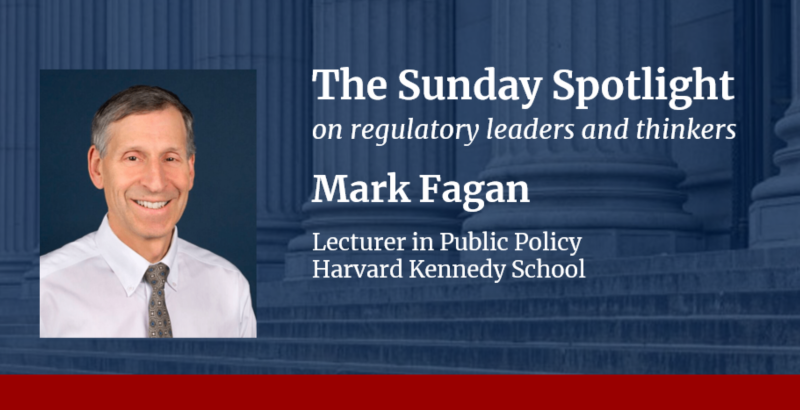
Mark Fagan discusses the current challenges and opportunities in autonomous vehicle regulation.
In a discussion with The Regulatory Review, Mark Fagan explains that autonomous vehicles pose unique challenges for regulators and argues for federal safety standards alongside state and local regulations to encourage innovation, promote safety, and resolve novel challenges as they arise.
Fagan discusses the different levels of autonomous capabilities possessed by self-driving cars and explains how each level raises distinct regulatory challenges. He argues that the federal government is best suited to define and certify safety requirements for autonomous vehicles, but state governments are better equipped to oversee the day-to-day operation of them. Although the development and user adoption of autonomous vehicles will remain slower than many have anticipated, Fagan is optimistic about the potential for autonomous vehicles to improve urban mobility.
Mark Fagan is a lecturer in public policy at the Harvard Kennedy School. Fagan leads the Autonomous Vehicles Policy Initiative at the Taubman Center for State and Local Government. He has more than 30 years of consulting with the public and private sectors and was a founding partner of Norbridge, Inc., a leading management consulting firm in the transportation sector.
The Regulatory Review is pleased to share the following interview with Mark Fagan.
The Regulatory Review: Self-driving cars have different levels of autonomous capabilities. How are these levels defined, and do they pose different challenges for regulators?
SAE International, a global professional organization for aerospace, commercial, and automotive engineers, has defined six levels of automation for cars. In Level 0, Level 1, and Level 2, the human driver dominates. In Level 2, the vehicle has the ability to support the driver with certain functions, such as steering, braking, and acceleration. Almost all vehicles have these capabilities. Level 3 vehicles are capable of driving autonomously but require driver intervention when the vehicle is uncertain about how to proceed. Levels 4 and 5 are truly autonomous. There is only a rider, not a driver. The differences between Levels 4 and 5 are the conditions and geography where the vehicles can operate. Level 4 vehicles can only operate in certain weather conditions and within assigned geofenced areas. Level 5 vehicles can operate anywhere at all times.
Today, there are Level 4 vehicles operating around the globe. There are not currently any Level 5 vehicles in service, although some are in development. In the United States, the largest autonomous vehicle operator is Waymo, a subsidiary of Alphabet. Other autonomous vehicle operators with vehicles in service or in testing include Zoox, Tesla, and May Mobility.
Policymakers face the greatest challenge in regulating Level 3 vehicles. Here, policymakers must decide what circumstances require the intervention. There is also a question about liability. If an accident takes place, who is the responsible party: the provider of autonomy or the driver? My personal opinion is that regulators should minimize Level 3 operations as the benefits of Level 4 are substantially greater.
TRR: Can current law appropriately assign liability in the event of an accident involving an autonomous vehicle, or must it be changed to accommodate autonomous vehicles?
If we focus on Level 4, autonomous vehicles will likely enhance assignment of liability in the event of an accident. First, the interaction between driver and vehicle is eliminated. The vehicle operator and developer bear total responsibility for its safe operation. Second, autonomous vehicles have extensive technology that enables a strong assignment of responsibility. The vehicle has Lidar, radar, video cameras, and audio receivers, all of which enable a fact-based postmortem after an accident.
TRR: Autonomous vehicle manufacturers have called for nationwide regulations so that they do have to comply with a patchwork of state and local regulations. What are the merits of this position? How should regulatory responsibilities be divided between federal and state and local regulators?
To date, the federal government’s involvement with autonomous vehicle regulation has been limited to voluntary safety guidelines. There is currently interest in a stronger role. In thinking about nationwide regulations, it is important to differentiate between the safety of the vehicle and its operations on the streets. Vehicle safety standards have long been the purview of the federal government. That role should be expanded to include autonomous vehicles. The benefits of having a single safety framework are essential for both cost-effective industry innovation and constituent safety. My personal view is that the federal government should both define and certify the safety requirements for autonomous vehicles.
When it comes to regulating the operation of autonomous vehicles on the streets, states should be in control just as they are for driven vehicles today. State policymakers are best positioned to determine how best autonomous vehicles should be brought into their communities based on their constituents’ interests and needs. Moreover, autonomous vehicles are a new technology, and allowing states to experiment with different operating models will enable the country to find the best approaches.
TRR: The SELF DRIVE Act was recently introduced in the U.S. of House of Representatives. What key regulatory challenges does this legislation address?
The SELF DRIVE Act, more formally titled the “Safely, ensuring lives, future deployment, and research in vehicle evolution act of 2026” seeks to “ensure continued U.S. leadership in the global automotive and autonomous driving sector, improve road, safety, mobility, and accessibility, and create American jobs by creating rules and regulations that relate to the design, construction, and performance of ADS—equipped vehicles by encouraging the testing and deployment of such vehicles.”
The Act would establish federal authority and preemption over state laws under the auspice of the National Highway Traffic Safety Administration (NHTSA) for design, designating the safety standards for advanced driving systems, including autonomous vehicles. The Act would also require manufacturers to submit safety cases demonstrating the safe operation of their vehicles. Moreover, it would extend the ability of manufacturers to test and deploy vehicles that do not comply with existing vehicle requirements, such as having steering wheels and braking mechanisms.
As described in my prior response about the role of federal regulation, the Act would codify the current role of driven vehicles extended to autonomous vehicles. This approach avoids a patchwork of safety regulations and likely more effectively protects communities. Again, the rules for operating autonomous vehicles should be established at the state level.
TRR: As companies such as Zoox and Tesla push for fully autonomous vehicles without steering wheels, pedals, and other traditional controls, should NHTSA safety requirements be maintained, or have they become outdated?
NHTSA safety requirements should be maintained yet modified to reflect autonomous vehicles. An entity overseeing the safe and standardized operation of autonomous vehicles is essential, and the federal government is the best place for that to take place. NHTSA has a strong foundation to work from, but it will need to bring in some additional autonomous driving system expertise. The risk of edge cases, low probability but high consequence in incidents, calls for enhancements to the NHTSA’s approach.
TRR: How might the mass adoption of autonomous vehicles transform cities, particularly in terms of congestion, land use, and public transportation?
Robin Chase, one of the co-founders of Zipcar, describes the world of autonomous vehicles as having either a heaven or hell scenario. The hell scenario entails zombie autonomous vehicles filling the streets with no one in them while their owner goes to a store for coffee. In this scenario, autonomous vehicles out compete with transit, both creating greater congestion and eroding public transportation. Also, long commutes now become attractive because time can be used productively, thus encouraging urban sprawl. The heaven scenario envisions shared autonomous vehicles so ubiquitous, cost-effective, and comfortable that car owners sell their vehicles, reducing the need for parking, which frees up space for more housing, retail, and parks. This, in turn, makes living in the urban core very attractive, limiting sprawl.
Over the next five years, neither of these scenarios will play out. The adoption of autonomous vehicles has taken place slowly, both as a function of refining the technology and also consumer adoption. On the technology front, it is incredibly complex to train a computer to replicate the decades of driving experience that we all have. The current approach to the training is mapping a discrete geography by operating a vehicle in test mode again and again and again. This process is time consuming and costly. Although the training process is getting faster, it still takes time. Consequently, the rollout is likely to be slow and steady, giving communities time to respond. There are opportunities for state and local regulators to encourage the heaven scenario. For example, local regulation can limit the pick-up and drop-off locations to minimize congestion. Another example is autonomous vehicles providing a last mile solution for those taking public transit.
The consumer adoption of autonomous vehicles has also been slow. For many, it is unnerving to ride in a vehicle operating without a driver. That said, my own experience is the “Rule of 3.” Take three rides in an autonomous vehicle and you will become very comfortable with the technology.
There is one additional key wildcard—people who provide for-hire transportation today. The Transportation Network Company drivers for Uber and Lyft view autonomous vehicles as an existential threat. Their political clout is not to be underestimated. Although they may not be able to hold back the autonomous vehicle tide, they may be able to slow it.
The bottom line for me is that autonomous vehicle assets need to be leveraged to optimize urban mobility. Smart regulation can facilitate that outcome.
Finally, if you have not been in an autonomous vehicle yet, try it out. The technology is mind bending.